 PrecisionRifleBlog.com A DATA-DRIVEN Approach to Precision Rifles, Optics & Gear
Related Articles


If you’re researching the best rifle stock for long-range shooting or PRS competition, one of the most helpful places to look is the rifles actually being used by the top shooters in the country. Every year, I survey the top 200 Precision Rifle Series competitors right before the PRS Finale and ask them about the exact gear they run in matches. That data provides a unique window into what’s working at the highest level of the sport. Instead of marketing claims or opinions, this article is built on real-world choices from the world’s best long-range shooters.
Over the past decade, the PRS has evolved dramatically, and so have the designs of modern rifle stocks. In this article, we’ll break down the best rifle stock and chassis systems used by the top PRS shooters, including which brands dominate the field and how those trends have shifted over time. Features like weight tuning, longer forends, integrated ARCA rails, and extensive adjustability have reshaped what competitors expect from a stock. Let’s dive into the data from the latest survey and see what the pros are actually running.
Year-Over-Year Trends for the Best Rifle Stock
We’ll start by looking at year-over-year trends of how popular the top brands are among pro shooters. I started collecting this data all the way back in 2012, so I graphed the most recent 3 years, plus 5 and 10 years before that. To keep the chart simple, I only included companies that represented at least 5% in one of those years.
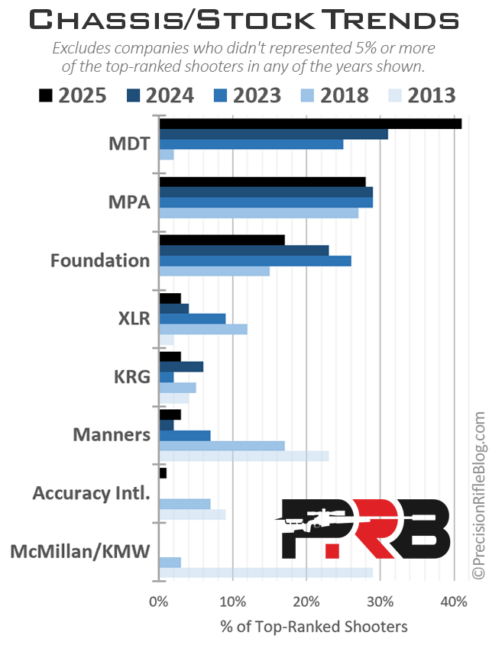
Modular Driven Technologies (MDT) has steadily grown in popularity every year. There wasn’t a single pro shooter using an MDT chassis in 2013, and only 2 pro shooters reported using an MDT chassis in 2018. Today, MDT represents 41% of the top 200 PRS shooters! That is the most dominant lead of any stock/chassis manufacturer among top shooters in the PRS since its first season in 2012!
Masterpiece Arms (MPA) has consistently represented 27-29% of these pro shooters from 2018 to today. Their chassis offerings and features have evolved dramatically over that period, which is why MPA remains one of the primary choices among top competitors.
Foundation Stocks is another company with a ton of pros putting their trust in their stock, representing 15-26% of the best shooters in the country from 2018 through 2025.
Over the past 3 years in the PRS, those 3 brands (MDT, MPA, and Foundation Stocks) accounted for 83% of the stocks and chassis pro shooters are running. They have been the dominant choices among serious competitors, although a few interesting new products have come to market recently that I’ll point out below.
Another interesting trend shown in the chart above is the sharp decline in popularity of traditional fiberglass stocks like McMillan Stocks. Back in the early days of the PRS (2012-2015), McMillan and Manners stocks were what virtually everyone was running. In fact, 48% of the top shooters were using a McMillan stock in 2012 (see the data)! Manners Stocks has kept pace with changing trends and features the top shooters are looking for, which is why Manners’ carbon-fiber stocks remain on the list. However, there wasn’t a single shooter using a McMillan stock this year.
Here are a few of the must-have features these pro shooters are looking for in modern chassis/stock designs:
- Ability to fine-tune the rifle’s balance point and weight, with the latest models moving more weight to the front (lighter butt) for better balance out of the box. (Read PRS Champion Morgun King explain how a competition rifle should balance and why it matters)
- Longer forends (15-19” compared to 10-12” on older designs), which provide shooters more flexibility for weight tuning and positional support on props
- Adjustability, including cheek and grip.
- Integrated arca rails along the forend (arca rails serve as a quick attachment interface for tripods, bipods, bags, and other accessories)
Deep Dive Into The Latest Data
Next, let’s take a quick look at how many of these pro shooters are running a stock vs. a chassis this year:
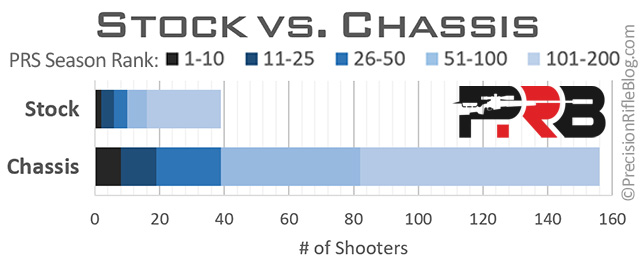
On the chart above, the various colors represent where a shooter landed in terms of season rank in the PRS. For example, black indicates shooters who finished in the top 10, the darkest blue is people who finished 11-25, and the lighter the blue, the further out they finished in overall standings. The chart legend itemizes the ranks each color represents, but basically, the darker the color, the higher the shooter’s overall ranking.
80% of pro shooters in the PRS opt for a chassis over a more traditional stock. That is up from 66% two years ago (view 2024 data). The lines have blurred in terms of what is a stock or a chassis over the years, but in general, chassis systems offer more adjustability, weight tuning, and accessory mounting options than traditional stocks, allowing competitors to optimize balance and ergonomics for positional shooting. However, I’ll point out a couple of stock options in this article that offer compelling features that chassis can’t.
Finally, the chart below provides a more detailed breakdown from my most recent “What The Pros Use” survey data:
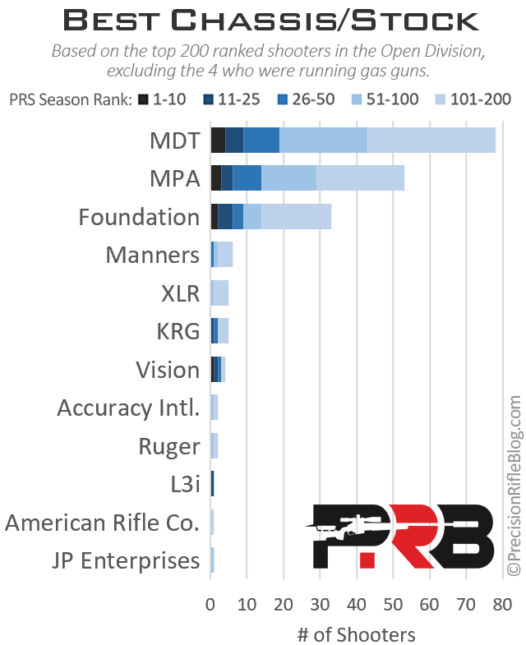
MDT Chassis: 41% of Pros
Modular Driven Technologies (MDT) has established a decisive lead as the most popular rifle chassis or stock among the top long-range competitors, representing an impressive 41% of the top-ranked PRS shooters this season. Even 4 out of the top 10 were running an MDT chassis, so it was represented across this elite group of marksmen.
MDT was founded in 2009, and they released the MDT TAC21 Chassis System that same year. So they have been a chassis specialist since they started, and long before chassis were mainstream. Then, in 2018, they introduced their competition-ready MDT Adjustable Core Competition (ACC) Chassis System. They purchased the design and patents for the JAE chassis (the J Allen JAE-700) in late 2019 and started producing it in 2020. In December 2022, they officially released their flagship competition chassis, the MDT ACC Elite Chassis System. Then in 2024, MDT released a new MDT CRBN stock that is designed for the lightweight hunting market, weighing in at just 30 ounces with the MDT Hunting Bottom Metal.
Here is a more detailed breakdown of the specific model of chassis or stock these pros said they ran in matches:
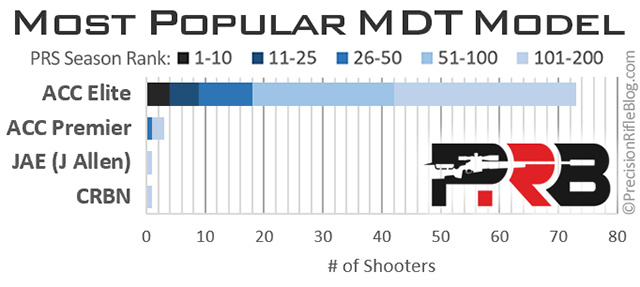
94% of those running an MDT chose the MDT ACC Elite Chassis, including everyone in the top 25. A few shooters were running the MDT ACC Premier Chassis, one shooter ran the MDT JAE Chassis (previously known as the J Allen chassis), and one ran the new MDT CRBN stock.
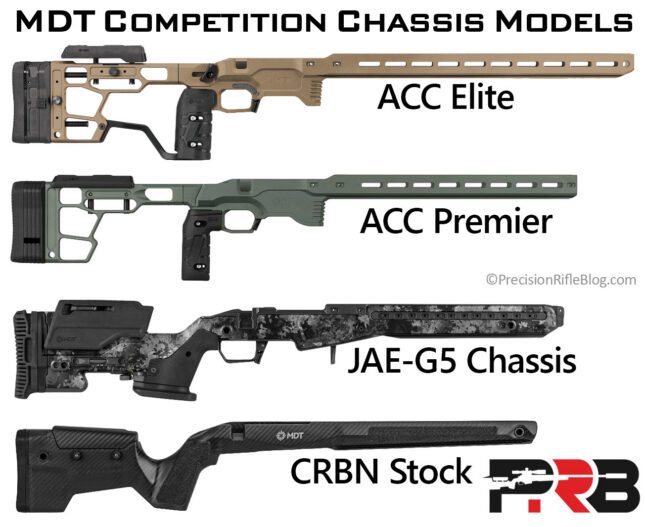
I want to add that the shooter running the MDT CRBN stock was competing in the new PRS Sportsman Division, which the PRS established in 2025. It has a strict 13.0-pound total weight limit, including the rifle, optic, muzzle device, bipod, empty magazine, and all detachable accessories. In comparison, the majority of competitors in the Open Division use rifle systems weighing 22-25 lbs. However, that one shooter using the MDT CRBN stock still had enough season points to rank among the top 200 in the Open Division – which is very impressive!
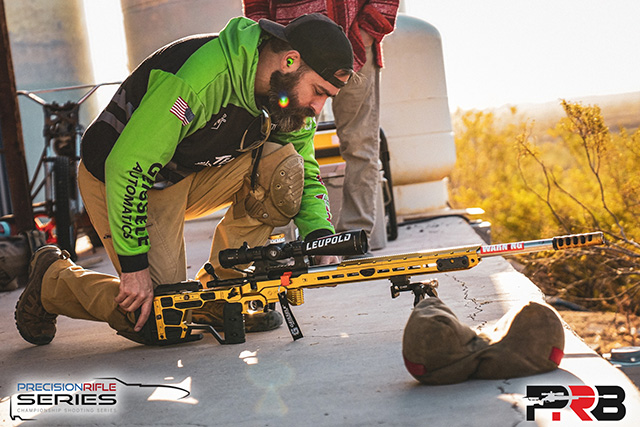
So why do so many pro shooters love the MDT ACC Elite Chassis? That likely varies from one shooter to the next, but here are a few reasons:
First, you can customize the MDT ACC Elite Chassis to your preferences and shooting style. It is very adjustable out of the box, including length of pull, cheek rest, distance from the grip to the trigger, grip angle, thumbshelf position, magazine tension, etc. Those adjustments aren’t just about comfort. When the rifle fits the shooter correctly, it promotes a natural and repeatable position behind the rifle, which is one of the keys to producing consistent hits at long range.
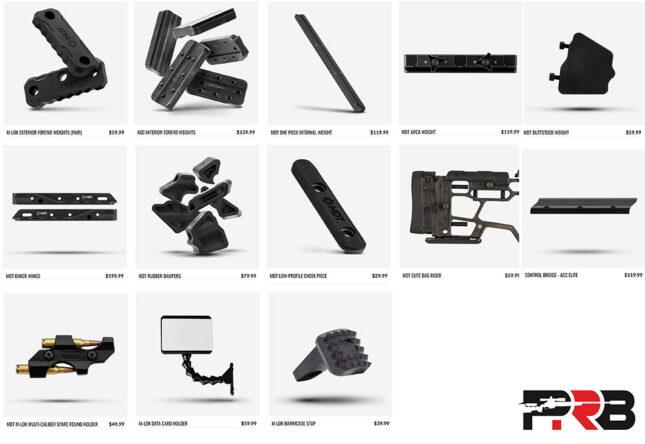
Second, there are also a ton of accessories available from MDT to customize and fine-tune the chassis to your preferences. That includes a variety of weights and cheek rests, as well as more exotic options like “Baker Wings” and rubber dampeners.
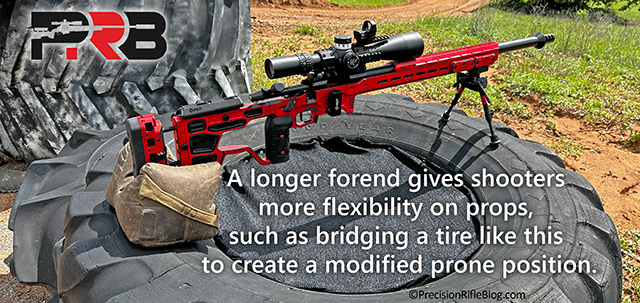
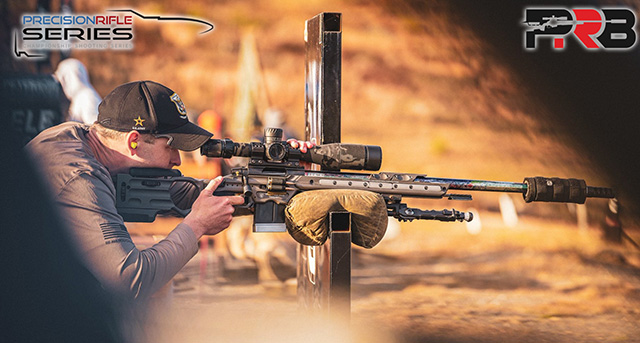
Third, many pro shooters also love the very long forend on the MDT Elite Chassis, which is the longest of any chassis on this list at 19”. The only other chassis close is the Vision Pro at 18.9”, but all of the others are more than 2” shorter. A long forend gives shooters more flexibility for weight tuning and positional support on props. It can also help you bridge barricades like tires, where you can get your bipod on the front part of the tire and butt of the rifle on a bag on the rear part of the tire for a steady modified prone position (shown in photo below).

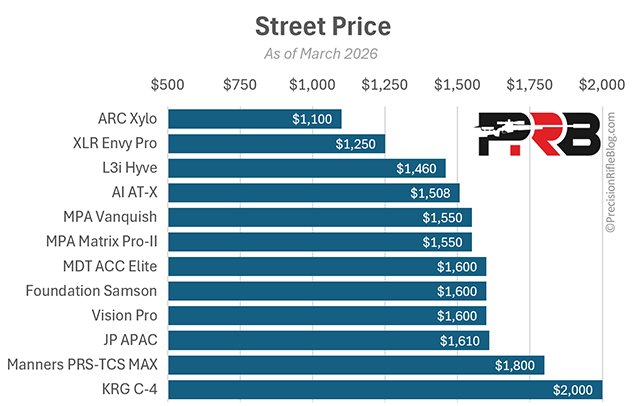
The street price of the MDT ACC Elite Chassis is $1,600 at the time this was published. For context, the average price of the stocks/chassis on this list is $1,552, so the MDT ACC Elite appears competitively priced.
MPA Chassis: 28% of Pros
28% of the top-ranked shooters run a Masterpiece Arms (MPA) chassis on their match rifle, including the shooter who placed 1st overall in the 2025 PRS Open, Morgun King (full breakdown of Morgun’s rifle, ammo & gear). The 2024 PRS Open Division Champion, Ben Gossett, also used an MPA chassis to win it all. So that’s back-to-back years that the golden bullet winner was running an MPA chassis.
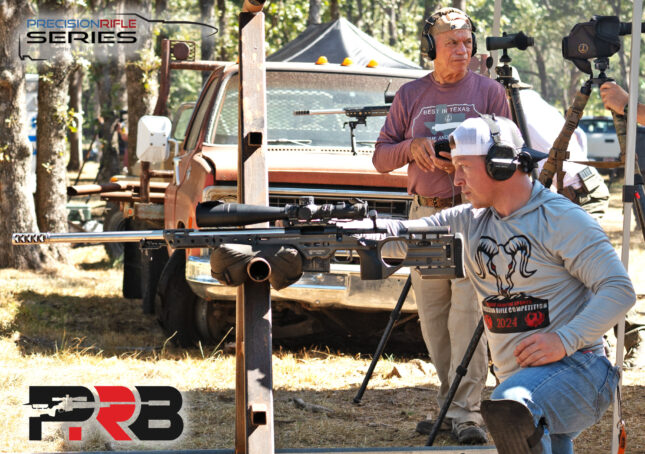
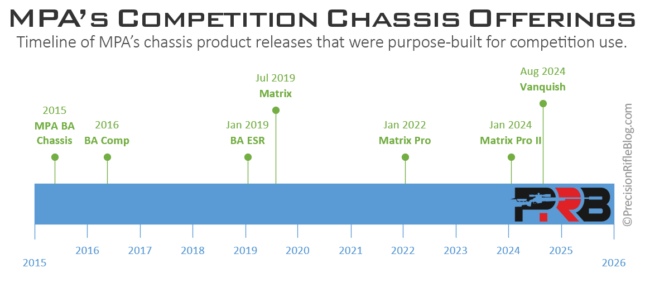
MPA has been one of the primary innovators in precision rifle chassis since 2016. They were the first manufacturer to start offering integrated arca rails, which was a game-changer for precision rifles. MPA has introduced a wide variety of chassis models over the past decade for shooters to pick from. Here is the full breakdown of which MPA chassis model these top-ranked shooters were running:
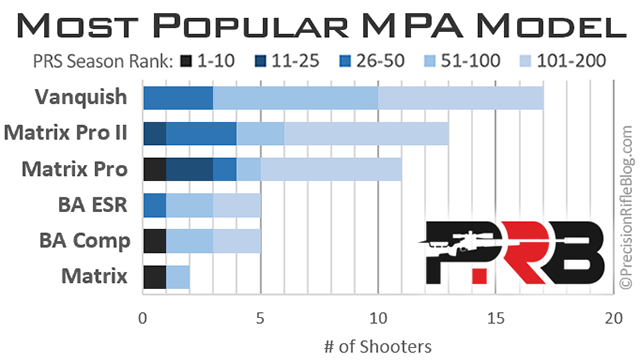
Of those running MPA Chassis:
- 32% Vanquish
- 25% Matrix Pro II
- 21% Matrix Pro
- 9% BA ESR
- 9% BA Comp
- 4% Matrix (including #1 Morgun King)
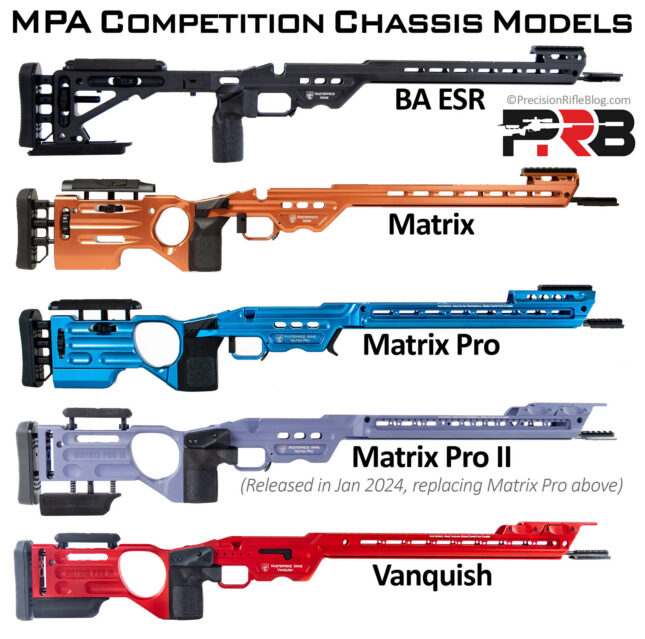
Because there are so many models, it can be a bit confusing – so here is a quick rundown of the timeline and differences in models, starting with the oldest design and moving to the newest.
- Baseline competition chassis: V-bedding, RAT (integrated 1.5” Arca) rail, built-in bubble level, NV bridge, bag rider, forend spigot, legendary EVG grip with thumb notch.
- Fore-end is the shortest of this group at 12”
- Max barrel diameter of 1.20” (meaning you can’t use a 1.25” straight barrel without modification)
MPA BA Enhanced Sniper Rifle (ESR)
- Built for mil/LE, with a longer fore-end (14”) and an enhanced longer night-vision bridge.
- Adds M-Lok on sides and bottom of the fore-end, plus Ultra Bag Rider (kept other features like arca rail, integrated level, EVG grip, V-bedding, etc.
- Max barrel diameter of 1.25”, allowing for heavier contours
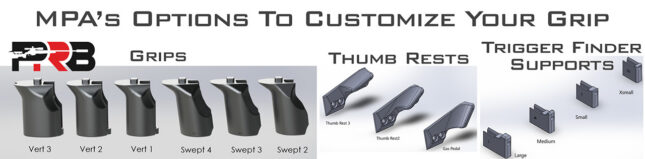
- First “Matrix” ergonomics chassis: 6 grip options (3 swept, 3 vertical), 3 thumb rest options, 4 trigger-finger support options – over 100 grip/hand interface combos.
- Fore-end is 2” longer than BA Comp and same length as ESR, with M-Lok on the sides and barricade-stop holes on the bottom.
- Still uses the BA architecture: arca rail, V-bedding, inclinometer, NV bridge options, etc.
- Adds integrated comp side rails to create a much wider fore-end for super-rigid bag support (Matrix forend width = 1.70”, Matrix Pro = 2.80”)
- Extended fore-end another 2” beyond the Matrix (Matrix Pro = 16.2”)
- Adds internal & external weight-tuning system, magwell plate system (for mag protection and bag support), Quick-Release bag rider, and a 1.35” barrel channel for big straight barrels.
- New lighter buttstock (over 1 lb lighter than previous Matrix Pro buttstock) to shift more weight forward for balance.
- New Nesting Bridge system along the top of the fore-end
- Still has the ultra-wide fore-end for maximum positional stability
- Adds a 7th grip option (the M-EVG grip) vs 6 on Matrix/Matrix Pro
- Built off the Matrix Pro II pattern but tuned differently in the nose: fore-end is ½” thinner and 6 oz heavier than Matrix Pro II, with all that extra weight in the fore-end for refined balance out of the box.
- Keeps the Matrix Pro II feature set: wide fore-end (just not ultra-wide), nesting bridge system, 7 grip options, 3 thumb rests, 4 trigger-finger supports, M-Lok on sides and bottom, enhanced buttstock with butt-hook.
No other chassis or stock offers so much control and customization over how your trigger hand interfaces with the rifle. That contact point becomes even more critical when shooting from improvised positions, where a poor fit can introduce torque as you press the trigger. MPA designed their system so the rifle fits like a glove and becomes an extension of your arm, helping you break consistent shots from any position.
There are also a ton of accessories available for MPA chassis from MPA and Gray Ops CNC, which allow you to customize your rifle to your specific preferences and shooting style.
The street price of the MPA Vanquish Chassis or Matrix Pro-II was $1,550 at the time this was published.
Foundation Stocks: 17% of Pros
Foundation Stocks continue to be a very popular choice, with 17% of the marksman at the top of the leaderboard choosing one of their micarta stocks, including #2 Austin Buschman (two-time IPRF World Champion, 2023 PRS Champ) and #3 Clay Blackketter (2019 PRS Champ).
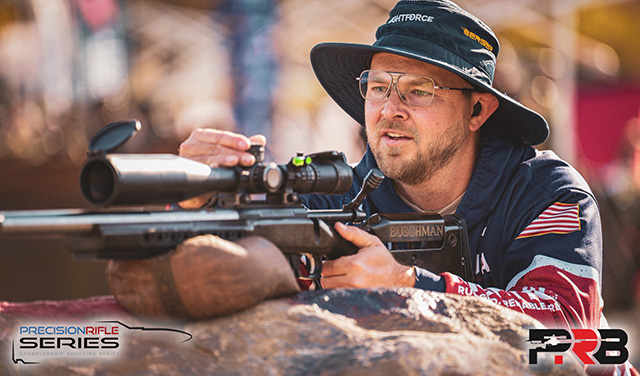
A Foundation Stock is essentially a modern version of a traditional rifle stock, machined from extremely rigid and dense micarta and shaped more like a classic stock. Each Foundation stock is custom-cut to the exact dimensions of a specific action, creating a perfectly matched surface that doesn’t need bedding. In contrast, MDT and MPA chassis are aluminum systems where the action bolts into a rigid V-block frame. Both are designed for precision rifles, but a Foundation Stock emphasizes traditional stock ergonomics while a chassis emphasizes modularity, accessory mounting, and mechanical clamping of the action.

One of the biggest benefits pro shooters often describe is that Foundation stocks feel “dead” during recoil. The dense micarta construction tends to dampen vibration, resulting in a smoother recoil impulse that can make it easier to spot bullet impacts. Aluminum chassis systems, on the other hand, tend to transmit more vibration through the rifle during recoil.
Here is why two-time PRS Champion Austin Orgain says that he chooses to run a Foundation Stock instead of a chassis:

“I did try some chassis. I tried some of the early Masterpiece Arms chassis. I tried an MDT chassis. I’ve tried an XLR chassis. I never liked the way the rifle felt through recoil. It felt like you were shooting a tuning fork to me. There was a lot of vibration and resonance in it. I did like the modularity of a chassis, but then the Foundation came out, and you still had some of the modularity with it by being able to add attachments using a rail. The Foundation stocks are made out of a material called micarta, which has a super, super dead feel to it. So you get virtually no vibration when you shoot the rifle. It just has dead recoil, and it’s solid. You don’t get that kind of tuning fork effect out of it like I felt like I would experience in the chassis that I ran.” – Austin Orgain
When Foundation Stocks were first released around 2017, some shooters complained about them being too heavy. However, since that time, the entire field of competitors has migrated to much heavier rifles. At SHOT Show 2024, they released a new Foundation Samson stock as their new flagship, competition-focused stock with a much heavier and more tunable weight system. The design allows configurations roughly 8.5 to 11.9 lb, reflecting that trend toward heavier PRS rifles.
You can see in the chart below that the Foundation Samson Stock has become the most popular option among these top-ranked competitors.
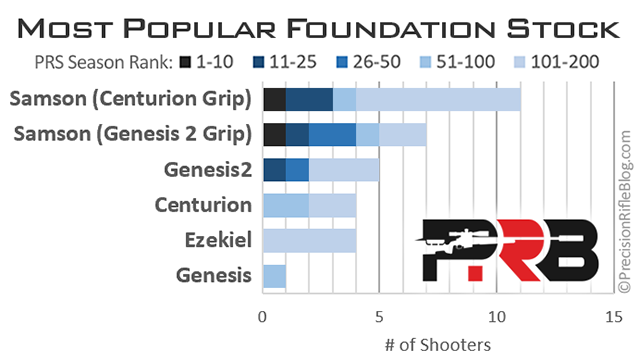
56% of those running a Foundation Stock chose one of the Foundation Samson Stock versions.
I created the graphic below by overlaying images of the two grip options for the Foundation Samson, so you could see the exact difference, which is purely in the grip. The Genesis 2 has a more traditional swept grip, meaning the grip is slightly angled. The Centurion has a vertical grip, which is more similar to grips you’d find on popular chassis designs. There are multiple shooters in the top 25 using either grip option, so it simply comes down to personal preference.
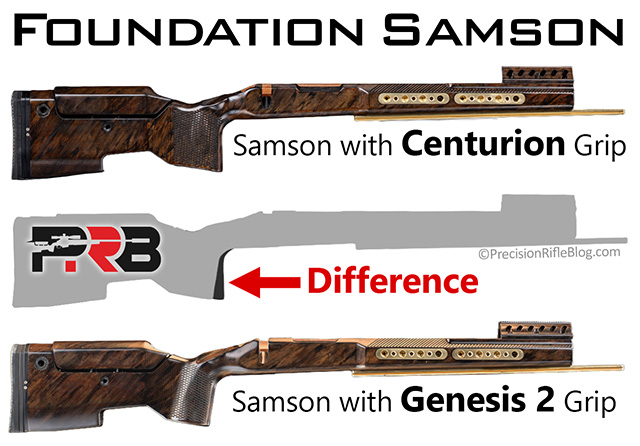
You can see in the images above that the brass arca rail included with the Foundation Samson extends beyond the end of the stock. The rail extends 15.75″ forward of the magazine well, which was another upgrade from older models and allows you to place bipods, bags, or even weights further out.
Even more recently, Foundation released new, lighter stock designs that are being used on high-end hunting rifles and also in the Sportsman Division in the PRS, which has strict weight limits. They refer to these new stocks as their Hybrid Hunting Stock line, and they feature a combination of micarta, kevlar, and carbon fiber, which is a completely novel approach for a rifle stock. The owner of Foundation stocks told me he originally hoped they could finish the product development on that in 6 months, but it ended up taking them several years! Here is what they say about it:
“Carbon fiber provides the stock extreme stiffness while the aramid fiber [aka kevlar] supplies excellent torsion and dampening performance and assures high impact strength. Using this in conjunction with our micarta bedding block has given us an extremely stiff, impact-resistant stock with unique dampening characteristics.” – Foundation Stocks on their Hybrid line of hunting stocks
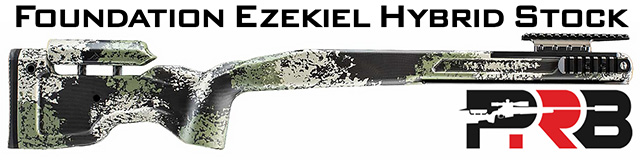
The Foundation Ezekial stock in their Hybrid Line is a very popular option for competing in the Sportsman Division in the PRS, and there were actually 4 shooters using one of those who had enough PRS Open Division points to be ranked within the top 200 in the Open Division. That means they were using a rifle that weighed about 10 pounds less than the typical competition rifle most competitors are using, and they still landed in the top 200! Very impressive!
To learn more about why some of the top pro shooters choose to run a Foundation Stock, check out my interview with two-time IPRF Open World Champion Austin Bushman or two-time PRS Champ Austin Orgain.
Street price for a Foundation Samson Stock was $1,600 at the time this was published. There is often a 4-6 month wait time for a Foundation Stock when buying direct, but you can also occasionally find them in stock and ready to ship from places like Altus Shooting Solutions.
Those top 3 brands of rifle stocks and chassis (MDT, MPA, and Foundation) account for 86% of the top 200 ranked shooters in the PRS this year. There are other good options I’ll cover below, but almost 9 out of 10 pros recommend MDT, MPA, or Foundation Stocks.
Manners Stocks: 3% of Pros
Manners Stocks has been one of the favorite options among top shooters in the PRS since it started in 2012, and there were 6 shooters inside the top 200 using a Manners Stock this year.
Here is a breakdown of the specific models of Manners stocks these elite competitors are using:
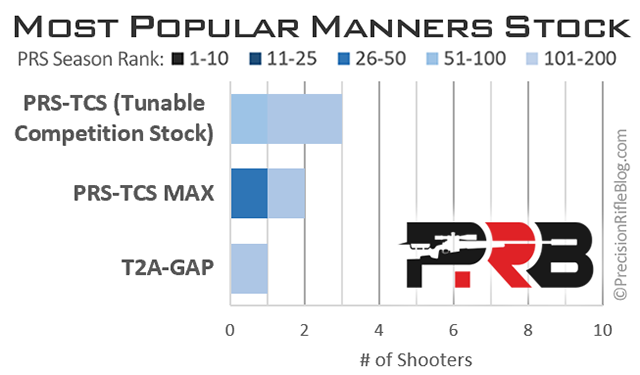
Manners stocks like the PRS-TCS, PRS-TCS MAX, and T2A-GAP are built from carbon-fiber composite shells with internal reinforcement, often paired with aluminum mini-chassis systems and weight-tuning hardware. Unlike aluminum chassis systems (e.g., MDT or MPA), the main structure of a Manners stock is a molded composite material.
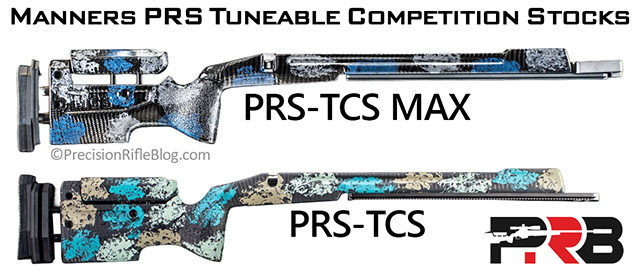
The standard PRS-TCS stock is a weight-tunable competition stock that lets shooters adjust balance using add-on weights in the Arca rail and butt. The Manners PRS-TCS MAX is designed to start heavier and more forward-balanced from the factory, using internal materials and weight distribution to achieve that balance without relying as much on external weights.
Street price for a Manners PRS-TCS MAX was $1,800 at the time this was published. That puts it $200 higher than the Foundation Samson, which could play into why it isn’t more popular among this group. Manners stocks are often made-to-order, and it’s not unusual for there to be 6-month wait times.
KRG Chassis: 3% of Pros
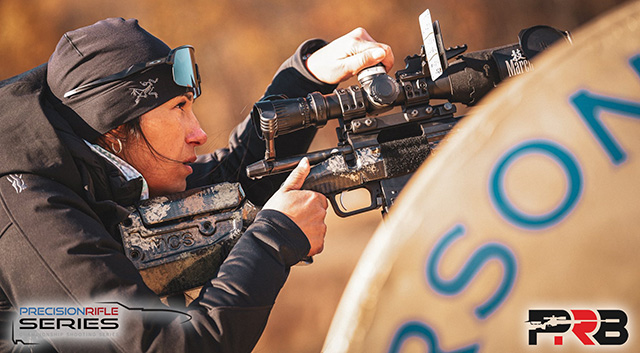
5 pro shooters ranked in the top 200 said they run the KRG C-4 chassis.


I noticed that one of those was Anthony Collie, who is a New Zealand shooter who finished 15th overall for the 2025 PRS Open Division. That is the highest season rank ever for an international shooter in the PRS Open Division. Anthony is a very respected shooter and competitor. I reached out to Anthony to ask what he loved about the KRG C-4 chassis and why he chose to run it over other options.
“The one-piece monolithic construction makes it super rigid. Also, the adjustability of the mag well is probably the best available. I’ve also never needed to bed an action in a KRG C4 chassis. I own 6 of them, and they have all been good. And they just look super cool! I’ve used KRG for a number of years and have always liked their chassis.” – Anthony Collie (15th in 2025 PRS Open Division)
As Anthony said, when you compare the KRG C-4 to popular chassis options like the MDT ACC Elite or MPA competition chassis, the KRG C-4 stands out for its one-piece monolithic chassis, which maximizes structural strength and rigidity. It also has one of the longer competition-style forends (16.75”). The KRG C4 also includes fine adjustments for magazine height and tension, allowing shooters to optimize feeding reliability even if pressure is applied to the magazine during positional stages.
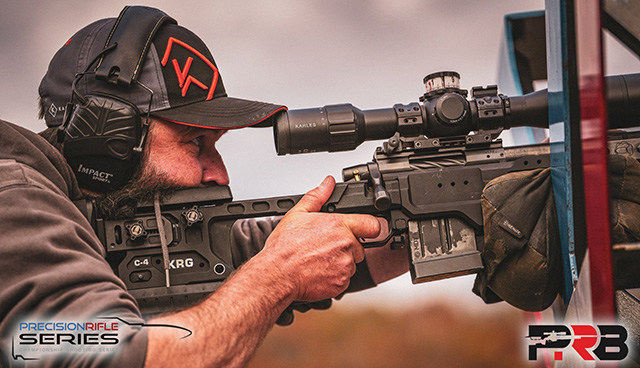
Note: When a magazine looks like that, it usually means the shooter has spent more time behind the rifle than most people spend on the internet arguing about gear. 😉
KRG is one of the few OG companies for precision rifle chassis, and they’ve been around since the earliest days of the PRS. They continue to evolve their game to stay relevant and offer the must-have features top competitors are seeking.
The monolithic design may add significant cost, because the KRG C-4 is priced at $2,000 at the time this was published. That is the highest price of any stock or chassis on this list, and it is 25% higher than MDT and MPA’s flagship competition chassis. I suspect the higher price likely contributes to the KRG C4 chassis not being more popular among this group, given how capable it seems.
XLR Chassis: 3% of Pros
5 shooters were running the XLR Envy Pro chassis. XLR makes a few models, but all 5 pros who use an XLR said they use the XLR Envy Pro. However, it is worth noting that none of the shooters in the top 50 were running an XLR chassis. XLR was the only one of the top 7 brands where that was the case.

The XLR Envy Pro has an extremely modular weight-tuning system, including internal steel weights and optional nose pieces that allow shooters to adjust both total weight and the rifle’s balance point. It also features a wide forend with thumb-index scallops, specifically designed for PRS shooters who pinch a front bag during positional stages.
You occasionally see an XLR Envy Pro that was machined from solid brass (photo below), which was a very limited-run/experimental version of the chassis (around 7-10 total made). Jake Vibbert ran one for a while, and I’ve seen a few others. The brass-chassis versions weigh around 16 pounds! Grant Watson used his solid brass XLR Envy Pro chassis at the 2025 PRS Finale and said his chassis alone can weigh up to 20 lbs with all the weights on it. Here is what he had to say about it: “I promise there is no chassis or stock in existence that is more ‘dead’ and vibration-free than them. People are truly amazed when they shoot mine.”
The XLR Envy Pro 2 had a street price of $1,250 when this was published, making it the second lowest-priced option on this list (only behind the ARC Xylo below).
Vision Chassis: 2% of Pros
4 of the top 200 ranked PRS shooters said they use the Vision Pro chassis, including #7 Jeff Guerry and #19 Derrick Warren. Jeff took 1st place in 7 PRS Pro Series matches in 2025, breaking the record for most Pro Series wins in a season, so clearly the Vision Pro chassis is capable of the highest levels of performance.
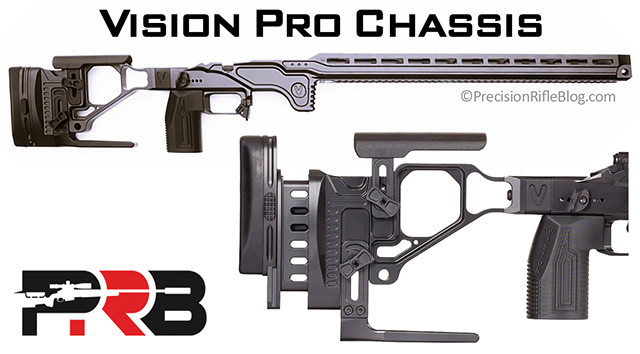
The Vision Pro chassis is a relatively new product, so I reached out to Jeff and Derrick to ask what they loved about the Vision Pro chassis and why they chose to run it over other options.
Here is what #7 Jeff Guerry said about the Vision Pro Chassis:

“The main thing that drew me towards the Vision Pro chassis was that it was made from 7075 aluminum, vs the 6061 that most of the other chassis seem to be made from. I got to feel one and immediately noticed just how much stiffer and denser it felt. That robustness was just something I hadn’t felt in a chassis at that point. Most of the other chassis I had used, like the MDT ACC Elite, XLR Envy Pro, and MPA’s, were made from the 6061 and felt more brittle to me, and I just would feel the vibrations with the recoil. The Vision seems to soak up a lot of those vibrations. Lots of people always mention that dead feeling you get when shooting a Foundation Stock. I think this Vision Pro Chassis is about as close as I’ve felt to that same feeling, but with all the adjustability of a chassis.
There are a few other features that are nice: the machining quality is awesome, the buttstock is very comfortable, very long forend, and the full-length top cover is nice. The grip is just okay, and the magazine adjustment screws are just okay as well.
So, it’s pretty much all because of the material to me, I think I honestly slightly prefer the feel/ergonomics of the MDT ACC Elite a little more. If MDT made that chassis out of the 7075, I’d probably give it a go.” – Jeff Guerry
Here is what #19 Derrick Warren said about the Vision Pro Chassis:

“I started running the Vision Pro chassis at the beginning of 2024. I had never even heard of Vision before they posted the video of the Pro chassis, but they seem to have really thought of everything. I’ve loved it ever since I got it.
The big thing that stands out is that it’s actually made out of 7075 aluminum. That may not sound like a big deal, but in practice, I’ve noticed it makes a huge difference. Where I’ve really noticed it is when I’m running a rear tripod and have a bag all the way out front on the rail—there is zero flex at all. You couldn’t flex the forend if you tried.
Another thing I really love is that it was designed from the ground up to balance perfectly out of the box with a 1.25-inch straight barrel. I run about a 22.5-pound gun, and I only have two sets of external weights on it—and that’s just to add weight. It balances great with just the heavy barrel and no other weights.
It’s not included with the chassis, but the full-length top cover is excellent for blocking mirage off the barrel and gives you a perfect place to rest your hand. One of the more interesting things about the chassis that I always like to point out is that the bore height is extremely low. In a sense, if you measure from the bottom of the chassis to the top of the barrel, it’s a lot less than other brands. The result is less muzzle rise because the fulcrum point is lower.
All in all, it’s just a really well-thought-out, premium chassis.” – Derrick Warren
Well, dang! Those two guys make me want to go buy one and try it for myself! I wouldn’t be surprised if we see MDT and MPA come out with 7075 aluminum chassis options a few months after this article is published. 😉
I also noticed the Vision Pro Chassis features an 18.9” forend, which provides more flexibility for weight tuning and support on props. It is very similar to the 19” one found on the popular MDT Elite. All other chassis and stocks are at least 2” shorter than the MDT Elite or Vision Pro chassis.
The Vision Pro Chassis had a street price of $1,600 at the time this was published.
JP APAC Chassis: 1% of Pros
3 of these top-ranked shooters were using a JP APAC Chassis, with one of those in the top 100.
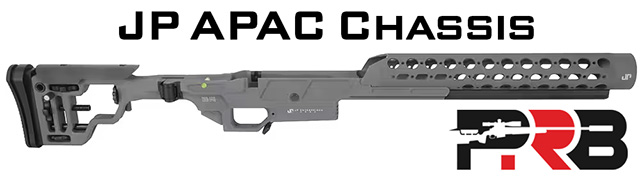
Most people know JP Rifles (aka JP Enterprises) for their work in the AR-15 competition world (e.g., 3-Gun), where many consider them the best of the best. The company says the JP APAC Chassis “broke the mold by porting over the superior AR ergonomics and interface to the bolt gun. This design draws from the real-world experience of our outstanding precision shooting team and collaboration with former U.S. Army sniper and precision shooter, Brian Whalen.”
I’d suspect some pro shooters might argue about whether the ergonomics of an AR-15 are “superior,” but obviously, a few of these guys love it.
The JP Chassis had a street price of $1,610 when this was published.
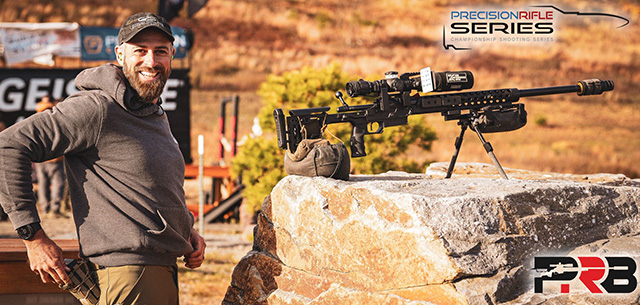
Accuracy International Chassis: 1% of Pros
2 shooters were using an Accuracy International AT-X Chassis. Both of them also said they were using an Accuracy International action, so I’d expect that these were complete AI rifles. You can buy the AI AT-X as a complete rifle or you can just buy the chassis that fits Remington 700 based actions.
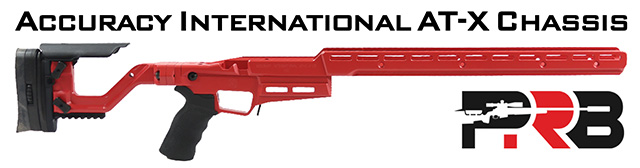
The AI AT-X chassis had a street price of $1,508 when this was published.
Ruger Precision Rifle: 1% of Pros
Lauryl Akenhead and Doug Koenig got 5th & 6th in the PRS Production Division using their factory Ruger Precision Rifle. They actually had enough season points to rank #72 and #152 in the PRS Open Division, which is how they ended up on this list. That is very impressive considering they were competing with factory rifles!
The street price for a complete Ruger Precision Rifle was $1,700 when this was published. That is for a complete rifle, and not just the chassis! The Ruger chassis may not be at the same level as the leaders on this list, it is the best value by a long shot. And it does have virtually all of the must-have features that competitors are looking for (adjustability, ability to add weights to tune balance, etc.) right out of the box.
If nothing else, this should encourage newer shooters: you don’t have to spend a fortune to compete in the PRS. While top pros may gain a few extra points from a rifle perfectly tuned to their preferences, most new shooters would need to fire thousands of rounds before they have the ability to realize that advantage. A factory rifle like the Ruger Precision Rifle won’t be the limiting factor for quite a while.
L3i Chassis: 1% of Pros
Only 1 shooter said they used a L3i Hyve Chassis, but he was one of the best: #13 Sam Gearing.
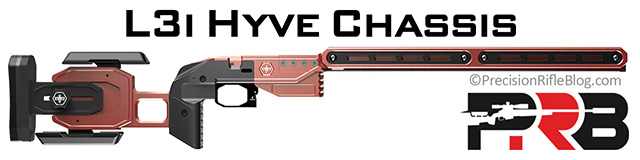
The L3i Hyve chassis is a competition-focused aluminum chassis designed around recoil management and balance tuning. Its unusually low bore-axis, internal weight pockets, and modular 3-piece architecture help shooters fine-tune the rifle’s balance and keep the gun tracking flat through recoil.
The L3i Hyve Chassis was $1,460 at the time this was published.
American Rifle Company Chassis: 1% of Pros
1 pro shooter in this group was using the American Rifle Company Xylo Chassis.
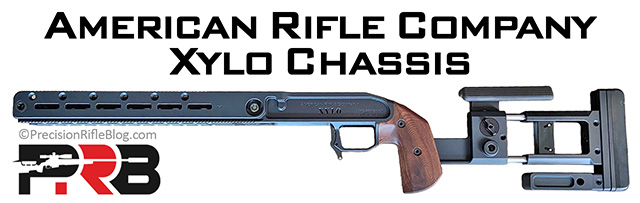
Ted Karagias, founder/owner of American Rifle Company (ARC), is one of the most brilliant engineers I’ve ever met, and he’s not someone who releases “me too” products that make incremental improvements to existing ideas. Ted tends to rethink the problem entirely and design something fundamentally different.
The American Rifle Company Xylo is a monolithic 7075 aluminum chassis designed to provide a very stiff and stable platform for precision rifles. Its most distinctive features include a lug-clamping action interface, a deployable bubble level positioned forward of the shooter’s eye, and a unique walnut grip intended to improve ergonomics and trigger control.
The ARC Xylo and Vision Pro are the only chassis in this list built from 7075 aluminum rather than the more common 6061. With nearly double the strength, 7075 helps create a more rigid platform that resists flex and keeps the rifle stable when shooting from supported positions. Other chassis manufacturers use 6061 aluminum because it is more affordable and easier to machine, which keeps manufacturing costs lower.
The ARC Xylo was priced at $1,100 at the time this was published, which makes it the lowest-priced option on this list. That seems crazy, considering this is made from 7075 aluminum, which we know is more expensive than the 6061 aluminum most chassis are made from. That’s 30% lower than the $1,600 options like the MDT Elite and Foundation Stock! The ARC Xylo seems like the clear standout when it comes to bang for your buck on this list.
Finally, here is a look at the street price of the most popular models from each brand, at the time this article was published:
To be the 1st to know when the next article goes live, sign up for email notifications:
Shop Using My Amazon Associates Link
If you buy stuff off Amazon, use the link below, and I get credit regardless of what you get or from what country you order – and you pay not a penny more! Amazon has an affiliate program that pays a small commission when readers use links from my website to buy stuff. You still get your stuff at Amazon’s great prices, and you can help support PRB at the same time.

Donate to PRB

Share on Facebook & Your Favorite Forum!
Like & Follow On Instagram
Follow @PrecisionRifleBlog on Instagram


Nothing and I mean nothing from MDT is reasonably priced.
Ha! I can understand what you mean, Mark. To be clear, I did say, “the MDT ACC Elite appears competitively priced.” But, I guess it’s all relative. They certainly aren’t the highest on this list, or even the 2nd highest … or the 3rd highest! Most of these shooters seem to clearly say they believe it is worth it. The answer to “Is It Worth It?” largely depends on your personal circumstances and the intended application. There is certainly no one-size-fits-all “right” answer. I’m not here to try to convince you to buy something from them. I’ve got no dog in this fight, as I’m 100% independent.
From my perspective, MDT seems to be finding a lot of success, and not just in the competition world. That means a lot of people are voting that it’s worth it with their wallet. Do I wish their stuff was less expensive? Sure! Who wouldn’t?! But, ultimately they offer a few great products … and many of them seem worth it me.
I actually have thought about that question a TON over the years, and feel like I summed up my view here: Is It Worth It?
But, “to each their own.” I appreciate you sharing your perspective.
Thanks,
Cal
MDT – buy one, then spend another $1k on accessories to make it shootable. Noisy and vibrates a lot.
MPA I like that its has a wider forend and slighy heavier then the MDT. Better ergos. Still noisy.
Manners/Foundation, buy one and done. And its much more pleasant to shoot.
Aluminum chassis do not belong in the rifle world. If aluminum was a good material for a rifle stock they would have never used wood. Nowadays a good piece of wood for a stock costs 10x more $$ then an aluminum block that will go in a CNC machine. What does that tell ya.
Aluminum chassis look great on a cover of a rifle magazine. A composite stock looks old school and outdated. Go to a PRS match and shoot both. If you do that, you will never buy a metal chassis to begin with. I had a chance to fire a Foundation Samson 2days ago. It felt like I shot a 22LR. Amazing stock.
Thank you for your amazing articles. You bring so much to the shooting sports community. I hope to meet you at a PRS match one day, thank you in person and buy you a beer.
Cheers
Thanks for sharing your thoughts, Joe. I’ve owned them all and can’t argue with some of your points. Its true that I did probably spend another $1,000 on accessories for my MDT, but I’d say that was all things that were my preference or “nice-to-haves” and not required to get it “shootable.” Not saying that wasn’t true for you, but just trying to present a balanced perspective. I will say that after buying the accessories the ergonomics and overall fit of that rifle fit me better than any other chassis I’ve owned – except for maybe the original MPA BA Comp. That EVG grip with the integral thumbshelf is still my favorite grip feel ever.
MPA makes great stuff, too. I know some guys who love the wide forend on the Matrix Pro and Matrix Pro-II. It basically mimics if you had the Baker Wings on the MDT or the Comp side plates on the original Matrix. But it’s a little too wide for my preference. I prefer the wide forend on the Vanquish, but it’s not ultra-wide like the Matrix Pro II. I own the Matrix Pro-II and the Vanquish, and tend to prefer the Vanquish … but it really comes down to personal preference. I know other pros who strongly prefer the ultra-wide forend on the Matrix Pro, so “to each their own.”
I also own a Foundation, and it’s what I’ve been using in matches lately. Last year I used both a MDT ACC Elite and Foundation Samson in pro matches – and before that I used an MPA in pro matches for several years. I definitely see the compelling factors for a Foundation Stock and the dense micarta compared to an aluminum chassis.
Now, I have to say that I disagree that wood is better and the only reason nobody is using that is because aluminum is cheaper than wood. Wood stocks aren’t superior for precision rifles.
Ultimately, I think some guys are chassis guys and some guys prefer more traditional stocks. It sounds like you fit into the later group. There are pros and cons to each. My first custom rifle was in a high-end Manners Stock. I have 3 rifles right now that are in KRG chassis. I’ve shot most of these brands, and there are pros and cons to each. I am intrigued by the Vision Pro Chassis. I hadn’t heard about it before, and I don’t need one more chassis … but I’ve had one in my shopping cart twice in the past 3 months that I’ve been working on this post! 😉
And I appreciate the kind words about the content. I really did work on this one on and off for 3 months. It was a ton of hours, but I enjoy trying to present all of this in a way that is balanced, factual, and helps new shooters understand the nuances and pros and cons that different brands and models bring to the table. Ultimately, I’m just an independent guy trying to help fellow shooters learn more about a sport that I love.
I hope to run into you at a match, too! I’m actually a recovering alcoholic that has been sober for 23 years TODAY! Kind of crazy to think about that. So, unfortunately, I’ll pass on the beer, but you could have one! 😉
Thanks,
Cal
Morgun actually runs a matrix fore end with the pro buttstock, not the original matrix in its config
I appreciate that, but I’m simply reporting what Morgun King himself answered on the survey. I had multiple choice with all of the MPA models, and he chose “Matrix” … so guess that’s what he’d say. Whether it is a Matrix with a Pro Buttstock or a Pro with a Matrix forend, it’s kind of a hybrid of sorts, so counting it one way or the other could be viewed as “wrong”. So I’ll just stick with what Morgun answered on the survey.
Thanks for the info!
Cal
I’d be curious to see what chassis the ELR (Ko1M / Ko2M etc) competitors run too.
Me, too! Unfortunately, I don’t know anyone who collects that kind of data among the top shooters. If you know someone, please send them my way!
Thanks,
Cal
Curious if you have the stats excluding shooters sponsored by the chassis/stock manufacturer they run in competition. Seems to me that MDT is sponsoring a fair number of shooters (I could be wrong).
Thanks.
It doesn’t exclude anyone, as sponsorships really aren’t advertised. It’s a good question, and something people always wonder about.
I’d say that sponsorships aren’t as widespread or as lucrative as most people think. I personally am one of these pro shooters, and while I’m not at the top … I certainly pay for my things. There are some at the very top that do get some free gear, but most of them chose to run it and then got offers from that manufacturer to help later. They weren’t “recruited” to use that gear by the manufacturer. That is extremely rare in this game.
I’m friends with a lot of these guys, and you wouldn’t believe how competitive they are. They are using the equipment they believe will give them the most impacts. If someone offered them $5,000 to run something they thought might cost them 1 point on the whole season, they wouldn’t do it. In fact, most are so hesitant to change up their gear in any way, that they might not even take the money if they thought it would be a wash. We have all learned the hard way that once your setup is consistent and you know it runs, changing something usually just introduces inconsistency or uncertainty. When you think that each pro matches costs us $1,000 to $2,000 out of pocket, and we do 6-15 of those per year … then trying to save money on a chassis doesn’t make a lot of sense, if it is going to impact the season in any way.
Honestly, I bet if you removed all of the shooters from this who are in some way supported or sponsored by a manufacturer, the overall rankings wouldn’t change significantly … if at all. This just isn’t a big sport with a lot of sponsorship money being thrown at it. I hope one day it grows to that point, but we are a long way from that today. So I feel like that means its safe to trust data like this.
Thanks,
Cal
Awesome write up. I know these take a long time and I look forward to everyone. Thanks again
Thanks, Mark. This one in particular took a TON of time. I’ve been working on it on and off since December. I’m thankful to finally cross the finish line and hit publish! 😉
I’m naturally curious and passionate about this stuff, so I can chase some rabbits!
Thanks,
Cal
As always, very interesting. Thanks Cal!
Thanks for the write up, Cal!
As usual, the presentation of the findings for last season is outstanding.
At the end of the day, for most new (and seasoned) PRS shooters, it comes down to what they feel they shoot best with their body type, build, and strength.
Having owned or currently owned some of the big ones on the list (MDT, Foundation, Vision), I would say that they are ALL amazing pieces of machinery. The nuances between many of the chassis’ usually come down to adjustability and accessories.
What I would say is that many of the top brands have amazing customer service. I have reached out to MDT, MPA, Foundation, etc for trivial things that I felt embarrassed to ask but they have all surpassed the necessary bar for customer service. I have never been disappointed. Additionally, these brands support the sport. You see not only their names out there, but the faces of those who are behind the scenes at the local and national matches
In the end… I will say, I am certainly biased. Having all 3 above, I always come back to my Foundations (having earned a Bullet shooting one all season has certainly tilted my scale, haha). Something about shooting them makes them special. When I can’t decide what to bring to the range, or I only have enough time to bring 1 rifle, or I want to introduce a new shooter to the sport or firearms in general, the Foundation comes out. They have a wonderful crew and represent the best of what our sport has to offer.
Looking forward to the next article.
Thanks, Dustin. I appreciate the encouragement. They are especially meaningful knowing that you own many of them. That tells me I had a balanced and fair presentation of all of it.
And thanks for sharing your balanced and fair perspective. They are amazing pieces of machinery! 11+ years ago, any of these would have been KILLER to have. There are huge improvements over the McMillan fiberglass stocks we were using back then. We’re fortunate to have so many great choices to pick from.
Its funny that I also own or have owned most of them (MDT, MPA, Foundation, Manners, KRG, AI), and I also keep going back to the Foundation. I can’t say that it is hands-down my favorite, but I literally could have taken any of these to the PRS Finale last season: MDT ACC Elite, MPA Vanquish, MPA Matrix Pro II, or Foundation Samson. I competed with a couple of those during the regular season, but it was the Foundation that I took to the 2025 PRS Finale. I’m not claiming it’s “superior” or that the “others are trash.” They are all good in different ways. I used the MDT ACC Elite at the 2024 PRS Finale, and I had the Foundation Samson then, too. But, I guess I find myself going back to the Foundation Samson lately.
I think there is something special about the micarta, and how it wraps around the action and behaves under recoil. It is rock-solid and reliable. I never seem to have issues with my zero changing even a tiny bit in that Foundation Samson, even if you accidentally ding your barrel rushing to get the rifle in/out of prop windows or cattle gates.
I probably naturally fall on the side of a “chassis guy.” I love the modularity and even the ergonomics of a chassis that is customized to me more than a traditional stock, and always have. The MDT ACC Elite or the MPA BA ESR are the two that I’d say “fit me like a glove” and “feel like an extension of my body.” I love those, too – but I took the Foundation Samson to the last 3 rifle matches, and it’s going with me to the next pro match.
As you said, we’re fortunate that a lot of these companies are great people who support the sport – and they also make great products. So, I’m not someone that gets dogmatic and says, “I’ll only ever shoot …” or “This brand is the best no matter what!” So I might be using something else by the time the 2026 PRS Finale rolls around … but I seem to keep going back to the Foundation lately. It’s special!
But, any of the these are very capable pieces of equipment, and it does mostly just comes down to personal preference and priorities. There aren’t clear losers in this group.
Thanks,
Cal
Has anyone run the competitions with what our troops are issued with? Just to see what would happen.
Hey, Pierre. I don’t know of any competitions that like that, but maybe someone reading these comments will chime in if they know of any.
But, I do like the thought experiment that you raise, so I’ll at least share my thoughts. I’d say if you handed all of these pros the same standard issue M4 carbine (aka AR-15), or the new M7 rifle (6.8×51mm), or the M110 SASS, or the Mk 22 Advanced Sniper Rifle … as long as it was the exact same for all of them, the guys who finished in the top 20 at a match would mostly still be in the top 20. There is a slightly different skillset shooting an AR-15 style weapon than a bolt gun, but it’s not dramatically different.
I guess how I think about it, the rifle and gear differences between these pro shooters aren’t the reason that they landed at the top of the leaderboard. They are world-class marksmen and competitors. This game isn’t just about shooting. It’s about being able to perform on demand (in a high-stress situation on the clock when everyone is watching), adapt to changing conditions, and overcome challenges that hit everyone through the course of a stage and a match. It’s about creative problem solving and stage strategy. Its about consistency. And you have to put in the 10,000 hours or 20,000 rounds fired at long range or whatever it is for your skill level to develop to a point to where you are capable of a podium finish at a national-level pro match. Having the best rifle and gear doesn’t get you there. Lots of guys have a rifle that is as good or better than Morgun King’s or other PRS Champions, but they’ll never break into the top 25 a single PRS Pro Series match. I’m not saying Morgun could win with a 22 rimfire or a budget Savage Axis rifle with a 3-9x scope, but the exact rifle used is a relatively small part of the equation. I think if Morgun traded rifles with anyone in the top 10, it is extremely unlikely that it would change the results.
So if you change out the rifle system to something else, as long as it was consistent for all the shooters, then I’d shocked if someone that finished the 2025 season in the top 50 wouldn’t also be the winner of the fictional season with that new rifle system.
That’s my 2 cents! Might not even be what you were asking, but we can see if anyone else knows of competitions where they use standard military issue equipment. I don’t think the PRS has anything like that.
Thanks,
Cal
Yeah. That’d be very interesting. This type of competition isn’t unusual in other sports. Match racing in sailing is like that. Two ‘identical’ boats. The crew is allowed to tune them the way they want but not add, change or remove kit. The crews swap boats half way through JIC one boat is a little faster. Everything is focused on finding the best crew.
That trading the rifle thing would be fun to see!…..I think that a “Soldier” Division would be fun with a standard issue weapon just to gather numbers. Of course they would have to do a 20 mile march with all equipment, sleep outside in a hole, eat MRE’s and then get yelled at by your Sargent!…..My old buddy and I used to talk about how they were putting too much “stuff” on the M4…..we of course were the open sights army and navy……the kids now are spoiled!……thanks for the great articles…
Minor comment – your graph of chassis/stock trends at the top of the article, which plots the data for the different brands over time, does not seem to agree with the data in your 2024 article. For example, in the 2024 graph has MPA ahead of Foundation followed by MDT. Your graph above has 2024 data as MDT, MPA, then Foundation? Am I missing something?
Hey, Sean. Very astute. That is a good question, and I can appreciate your attention to detail! 😉 I can see why it’s confusing.
So each year, I collect the data from the pros either right before or after the PRS Finale, which is November/December. That is when you’d know who the top-ranked shooters were for that season, and typically shooters who qualify for the PRS Pro Series Finale are required to complete my survey before they can register for the end-of-year finale. So you should think about the data as the end-of-season or just before the start of the next season.
So the last time I published an article on stocks/chassis was March 15, 2024. That would have been based on the data I collected I couple of months earlier in Nov/Dec 2023 … not Nov/Dec 2024. In this chart “2024” would indicate the Nov/Dec 2024 data, and “2023” would be the Nov/Dec 2023 data.
Hope that makes sense! Sorry for the confusion.
Thanks,
Cal
Got it! Thanks for the clarificatin.