PrecisionRifleBlog.com A DATA-DRIVEN Approach to Precision Rifles, Optics & Gear
Related Articles
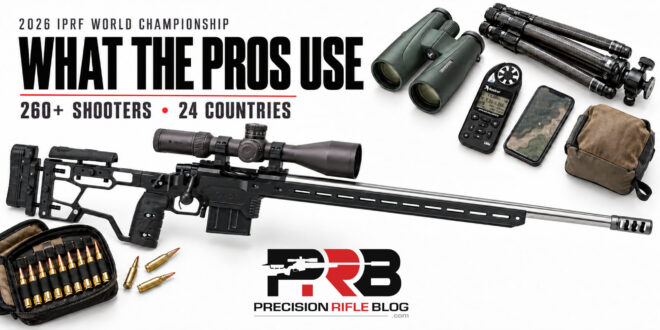
What does a precision rifle setup look like when the shooters come from around the world? I surveyed all 260+ competitors representing 24 countries at the 2026 IPRF World Championship. This article puts all of those gear choices in one place, from the cartridge and rifle action to the optics, ammunition components, bipod, tripod, and ballistics software.
I first shared this gear data on Instagram, with the charts colored by shooters’ predicted ranks from my World Championship predictions article. Follow @PrecisionRifleBlog on Instagram for early looks at data like that. You can also check out the predictions article to see how I ranked the field heading into the match. This article will show every piece of gear based on actual finishing positions of the match and not predictions, although the overall picture didn’t change dramatically.
If you look at the match results, you’ll see some familiar PRS names: Buschman, Harmon, Rudasill, Guerry, Blackketter, Colon, King, Heckler, Orgain, Caruso, etc. But the international perspective adds something different. Only 30 of these shooters represented the United States; the other 230+ represented 23 other countries. For example, Vihtavuori was the most popular powder brand across this field, while 26 of the 30 U.S. shooters chose Hodgdon. That is a substantial difference within the same match!
The International Precision Rifle Federation (IPRF) World Championship brings national teams together to compete for individual division and team titles. The 2026 competition took place September 24–27 at Gravestone Precision Shooting near Lipan, Texas. These shooters earned their places through their countries’ qualification and selection processes. Team USA’s process, for example, used an 18-month qualification window and required at least six designated matches, including a PRS Pro Series Finale. Other countries set their own selection procedures. (About the event | Team USA selection)
All of the charts below include shooters across all divisions. The colors show their overall placement by total impacts, regardless of division. The chart legend itemizes the ranks each color represents, but basically, the darker the color, the higher the shooter’s overall ranking. IPRF awards individual titles by division, so these overall places are simply a way to compare equipment across the field.
I normally take time to explain things thoroughly so nobody feels lost, even if they’re new to precision rifles. But with all of this gear packed into one article, I’m going to move faster than usual and focus on the highlights. If something isn’t clear or you want to dig deeper into a particular piece of gear, look for the “Read more” links in each section. Those will take you to previous articles where I explain the details, features, and tradeoffs in more depth.
Let’s dive into the data!
Most Popular Rifle Calibers
Let’s start with caliber. Caliber is how wide the bullet is, regardless of the particular cartridge the gun is chambered in.
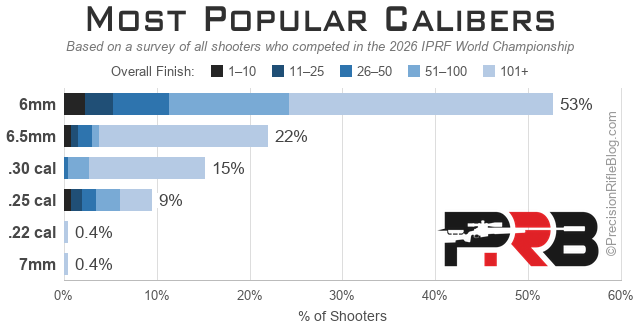
6mm was the most popular caliber, used by 53% of the shooters. The 6.5mm was the next most popular at 22%. Behind those was the. 30 caliber at 15%, which was all of the guys in the Limited Division, which requires shooters to use a rifle chambered in .308 Winchester / 7.62×51 NATO. That division requirement is useful context when reading the chart. Finally, 9% were using a 25 caliber, which is between a 6mm and 6.5mm.
The practical tradeoff is recoil versus what you can see downrange. A 6mm firing a typical match bullet recoils less than the larger options, which helps you stay on target and watch your own impact. A 6.5mm generally delivers more energy on target and can make a hit or miss easier to see, but asks more of your recoil management. The .25 caliber sits between them, with modern match bullets offering a useful balance of those qualities. The .30-caliber group is different: the Limited Division rules largely drive that choice, so its popularity should be read in that context. A 308 is going to recoil more than any of the other choices.
3 different calibers were represented among the shooters with the 10 highest scores: 6 used 6mm, 2 used 6.5mm, and 2 used .25 caliber.
Read more: Deep dive into caliber choices
Most Popular Rifle Cartridges
Now let’s look at the specific cartridge that these competitors’ rifles were chambered in:
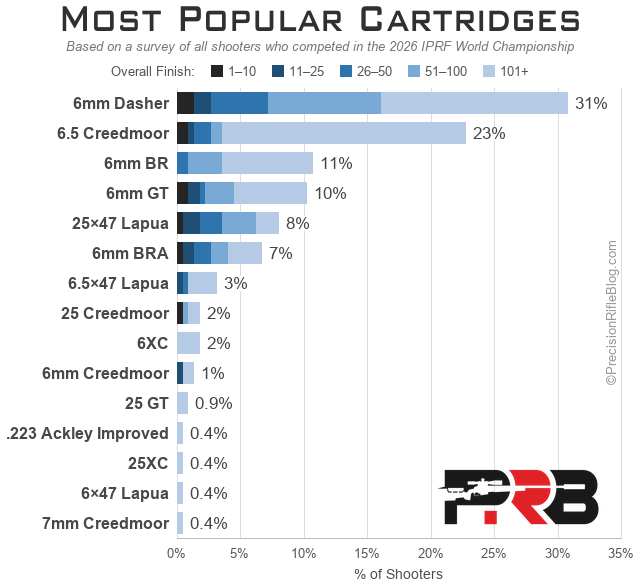
This chart represents what competitors chose to run when they had the freedom to pick from any cartridge. I specifically excluded the .308 Winchester from the chart data above, because that is what all shooters in the Limited Division were required to use. Nobody outside of the Limited Division chose to run a .308 Win.
The 6mm Dasher led the cartridge chart at 31%, followed by the 6.5 Creedmoor at 23%. Together, those two cartridges accounted for 54% of the shooters represented in this chart.
The Dasher’s appeal is consistency with manageable recoil. In my previous article about cartridges, top shooters repeatedly described it as straightforward to tune, and great Dasher brass options that come ready to load. The 6.5 Creedmoor offers a different kind of convenience: broad support in factory rifles, match ammunition, and components, plus heavier bullets that leave a more visible signature downrange. Its extra recoil is the tradeoff. These are two well-supported paths into competition, with different strengths.
The next group was fairly close: 11% used 6mm BR, 10% used 6mm GT, 8% used 25×47 Lapua, and 7% used 6mm BRA. Interestingly, all of the 6mm BR shooters were from outside the United States.
Among the top 10 overall finishers, six different cartridges appeared: 3 used a 6 Dasher, 2 used a 6.5 Creedmoor, 2 used a 6 GT, and then there was 1 of each of these: 25×47 Lapua, 25 Creedmoor, 6mm BRA. (Note: That is based on all divisions combined, excluding Limited Division.)
If you are choosing a cartridge for precision rifle competition, this is a useful shortlist of options that were represented at the top of this match. Each has pros and cons, but none of those choices would be the thing that held a shooter back.
Read more: Deep insight from pro shooters on cartridge comparisons and trade-offs
Rifle Scopes
Now let’s look at what brand of scopes these competitors from around the world chose to run:
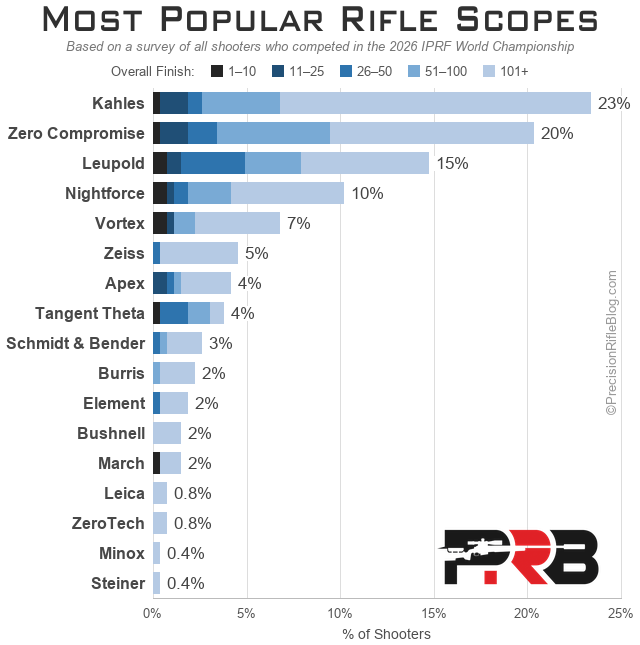
Kahles was the most popular rifle scope brand at 23%. Zero Compromise followed at 20%, Leupold at 15%, and Nightforce at 10%. Together, those four represented 69% of the shooters who specified a scope brand.
Kahles and Zero Compromise are particularly worth exploring if most of your experience is with familiar U.S. brands. Kahles’ recent K540i emphasizes a wide field of view, which helps you find the next target without dialing down your magnification as far. ZCO offers 10-mil-per-revolution turrets on models such as the 5-27×56 and 8-40×56, which is something many competitive shooters find appealing.
Leupold’s Mark 5HD offers comparatively low weight and very popular reticle options with 1/4-mil references. Nightforce’s ATACR line combines a long track record in competition with options such as the 7-35×56 F1. Field of view, turret details, and a reticle you can quickly reference can all matter when you are moving between targets on the clock.
Seven scope brands appeared among the overall top 10 (all divisions combined): There were 2 shooters using each of these brands: Leupold, Nightforce, and Vortex. Then there was 1 shooter using each of these brands: Kahles, Zero Compromise, Tangent Theta, and March.
All Brands: Kahles, Zero Compromise, Leupold, Nightforce, Vortex, Zeiss, Apex, Tangent Theta, Schmidt & Bender, Burris, Element, Bushnell, March, Leica, ZeroTech, Minox, Steiner
Read more: Scope features and model comparisons
Stocks and Chassis
Next, let’s look at the brands of chassis or stocks these guys were running at the 2026 IPRF World Championship:
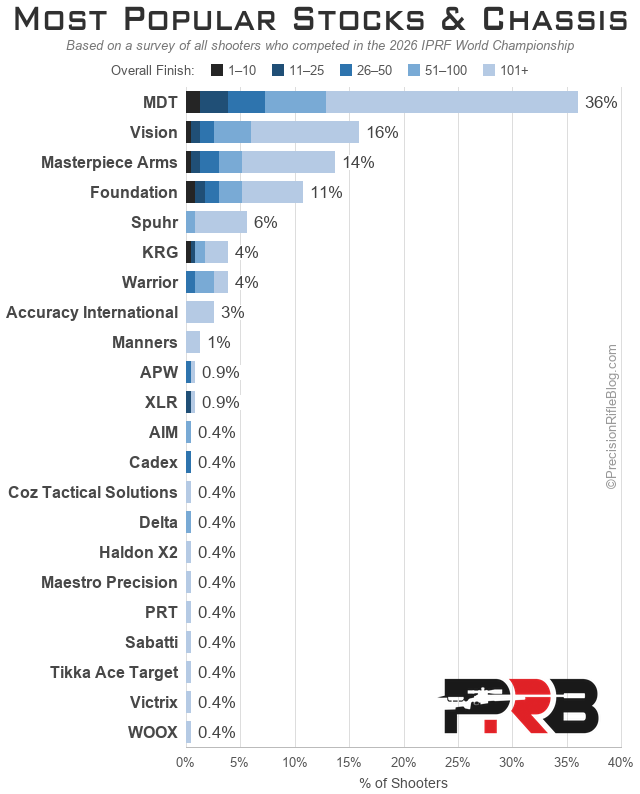
MDT was the most popular stock or chassis brand at 36%, followed by Vision at 16%, Masterpiece Arms at 14%, and Foundation at 11%. Those four brands accounted for 76% of the specified component answers.
MDT’s share was more than twice the next most popular brand. The MDT ACC Elite is their flagship, competition-focused product, featuring a long forend, adjustable grip and buttstock, and numerous weight-mounting options. Those features let you fit the rifle to your body and place its balance point where it settles naturally on a barricade bag.
Vision is a Norwegian manufacturer worth a closer look. The Vision Pro chassis uses 7075 aluminum and a long forend with extensive adjustment. 97% of Vision’s users represented countries outside the United States, so it was an extremely popular option among international shooters. But, Jeff Guerry and Derrick Warren both use a Vision Pro chassis in the Precision Rifle Series, and both of them are currently ranked in the top 5 for the 2026 Pro Series season standings – so clearly it is popular among some great US shooters, too. It is simply a lesser-known brand among US shooters, but is clearly competitive at the highest levels.
Masterpiece Arms’ Matrix family takes how your hand interfaces with the rifle particularly seriously, with interchangeable grips, thumb rests, and trigger-finger supports. That lets shooters tailor the contact points instead of adapting their hand to one fixed grip. The Matrix Pro II or Vanquish are MPA’s most popular chassis models for competition shooters.
Foundation Stocks takes a different approach, machining its competition stocks from dense micarta with an inlet matched to the action. The stock-like shape and recoil feel are part of the appeal. Shooters I interviewed said the Foundation stocks give a damped, “dead” feeling through recoil. It is a useful option for someone who prefers traditional stock ergonomics while retaining ways to tune balance and mount accessories. The Foundation Samson is their most popular model for competition shooters.
Spuhr accounted for 6% of the stock and chassis responses, while Warrior and KRG each accounted for 4%. The links below are a good place to explore some of the products behind these names. Among top-10 finishers with separate stock or chassis answers, five different brands were represented: MDT, Foundation, Vision, Masterpiece Arms, and KRG.
All Brands: MDT, Vision, Masterpiece Arms, Foundation, Spuhr, KRG, Warrior, Accuracy International, Manners, APW, XLR, AIM, Cadex, Coz Tactical Solutions, Delta, Haldon X2, Maestro Precision, PRT, Sabatti, Tikka Ace Target, Victrix, WOOX
Read more: Stock and chassis features explained
Rifle Actions
Now let’s look at the actions/receivers that these guys were running on their custom rifles:
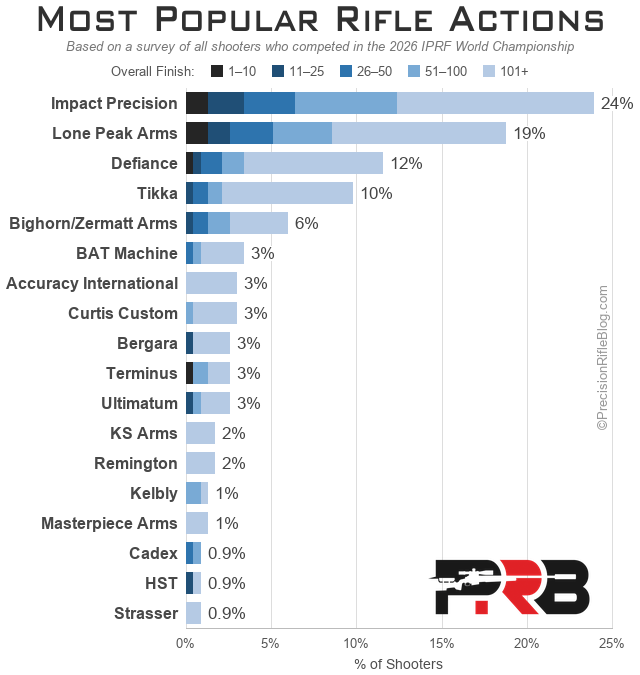
Impact Precision led the action responses at 24%, followed by Lone Peak Arms at 19% and Defiance at 12%. There were also a surprisingly high number of Tikka actions, at 10%.
Many of these are custom actions that are built around a Remington 700 action footprint, which allows you to use a variety of aftermarket stocks/chassis and triggers. Another huge benefit some of these actions have is support for shouldered pre-fit barrels, which can make replacing a worn competition barrel much more convenient. The 3 at the top of the list offer models with those features, plus other features, like an integral recoil lug and scope rail, and short-action configurations that accept both AICS and AW magazines.
Impact Precision’s 737R and Lone Peak Arms’ Fuzion have all of those features. Defiance offers a particularly broad range of models and configurations. One useful distinction when shopping is that models such as the Defiance Ruckus have guaranteed headspace for pre-fit barrels; that should not be assumed for every older Defiance action.
The U.S. and international breakdown is interesting here. Impact actions accounted for 64% of U.S. responses, compared with 19% of international responses. Lone Peak accounted for 12% and 20%, respectively. Among top-10 finishers (who weren’t using a factory rifle and therefore could choose their action), Impact and Lone Peak each represented 38%, while Defiance and Terminus each represented 13%.
There were also 10 additional action brands, each representing 1 shooter, which I excluded from the chart to keep it more readable. But they are all included in the complete list below.
All Actions: Impact Precision, Lone Peak Arms, Defiance, Tikka, Bighorn/Zermatt Arms, BAT Machine, Accuracy International, Curtis Custom, Bergara, Terminus, Ultimatum, KS Arms, Remington, Kelbly, Masterpiece Arms, Cadex, HST, Strasser, BCM Europearms, Black Rain Derecho, Borden, Falkor 7even, Howa, Ralph Badenhorst, Ruger, Sabatti, Sig Sauer, Victrix
Read more: More on custom rifle actions
Rifle Triggers
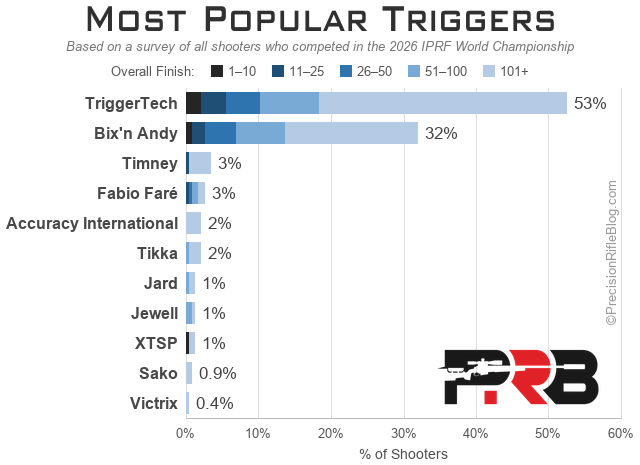
TriggerTech and Bix’n Andy accounted for 85% of these shooters!!! TriggerTech led at 53%, followed by Bix’n Andy at 32%. Timney and Fabio Faré each rounded to 3%, while Accuracy International and Tikka each accounted for 2%.
TriggerTech’s Diamond uses a roller between the trigger and sear to reduce sliding friction and creep. Bix’n Andy’s TacSport family uses a ball-bearing mechanism and offers replaceable trigger shoes and a housing that can be opened for maintenance/cleaning. Both address the same practical need: a predictable break that helps you fire without disturbing the rifle. Their feel and options differ, but they are both clearly world-class triggers.
Among overall top 10 finishers, 63% used TriggerTech, 25% used Bix’n Andy, and 13% used an XTSP trigger. (Note: Those percentages exclude the Factory Division, since they couldn’t pick from any trigger like the other divisions.)
All Trigger Brands: TriggerTech, Bix’n Andy, Timney, Fabio Faré, Accuracy International, Tikka, Jard, Jewell (out of business), XTSP, Sako, Victrix.
Read more: More on competition rifle triggers
Factory Rifles by Brand and Model
Before we move past rifle components, let’s see a breakdown of the brands of rifles that the shooters competing in the Factory Division were using. Competitors in this division are required to use “a non-custom, standard stock rifle, manufactured/assembled by a single mainstream manufacturer.” Shooters must “compete with the rifle as it comes from the factory,” with only a few specific modifications permitted. There are no price point requirements.
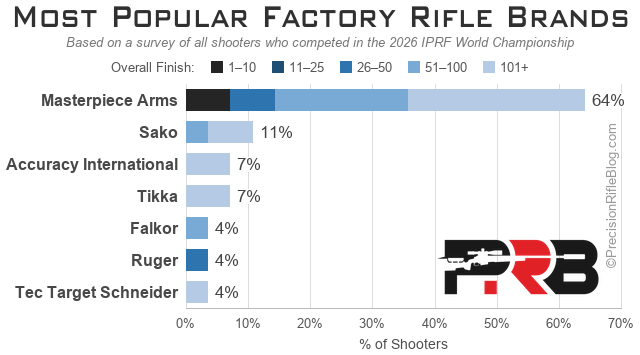
Masterpiece Arms accounted for 64% of their rifles! Sako followed at 11%. Accuracy International and Tikka each accounted for 7%, while Falkor, Ruger, and Tec Target Schneider each accounted for 4%.
Now let’s look at a more detailed breakdown of the specific model of factory rifle that each of them said they were using:
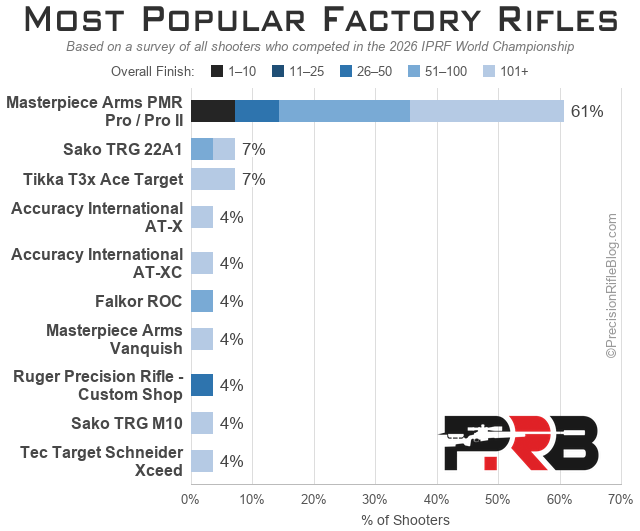
The results above show that “factory” does not mean an entry-level hunting rifle with a few upgrades. The results show a huge range of price points, from $2,000 for the Tikka T3x Ace Target to $12,000 for the Sako TRG M10!
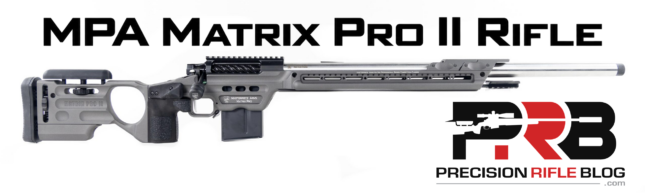
For the model chart, I combined the MPA PMR Pro and Pro II answers into one row. That group accounts for 61% of the Factory Division rifles, with the MPA Vanquish shown separately at 4%. Keith Rudasill won Factory Division with an MPA Matrix PMR Pro and recorded the highest overall score at the match: 192 impacts out of 200. Matthew Caruso, also shooting an MPA, placed 10th on that combined list. Those are useful examples of the level of performance represented in Factory Division.
MPA’s share exceeded every other brand combined and was six times as popular as the next brand. That is a decisive lead! Its competition rifles put features like an adjustable chassis, a very capable action, and a match trigger into a complete package. The Matrix Pro family also offers extensive grip and thumb-rest choices, so the rifle can be custom-fitted to the shooter.
Masterpiece Arms PMR rifles are priced from $2,800 to $3,600, which is an incredible value for a fully loaded competition rifle.
All factory rifle brands: Masterpiece Arms, Sako, Accuracy International, Tikka, Falkor, Ruger, Tec Target Schneider.
Bipods
Next, I asked, “What brand of bipod do you use on most stages?” I phrased it that way because at least some competitors may carry more than 1 bipod at a match. Most shooters will typically use the same bipod for most of the match, but might swap to another for a particular prop (like tires). But the data below should represent what they have on their rifle for most of the match.
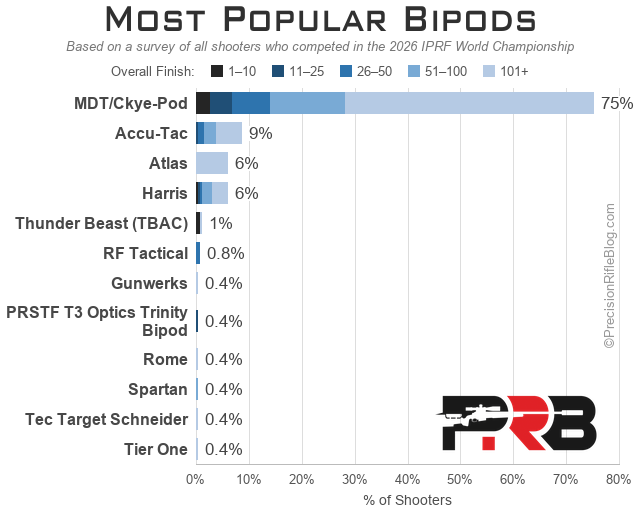
MDT Ckye-Pod was the most popular bipod at 75%!!! That is more than three times the share of every other bipod brand combined! Elite shooters worldwide seem to see the compelling competitive advantage an MDT Ckye-Pod can provide.
The Ckye-Pod’s main attraction is how many positions and configurations it can accommodate. Independent leg adjustment, a huge range of cant, and the extra height available in double- and triple-pull versions can help you build a supported position on virtually any terrain or awkward props.
I didn’t ask these shooters specifically which model of Ckye-Pod they were running on the survey, but among the top pro PRS shooters, the Double-Pull has always been the most popular choice. I attended 1 day of shooting at the 2026 IPRF World Championship, and it seemed the Double-Pull was the most popular among this group as well. Learn more about the different versions of the Ckye-Pod and what the pros use.
Accu-Tac followed at 9%, while Atlas and Harris each accounted for 6%. Among the top 10, 70% said they primarily used an MDT Ckye-Pod, 20% used Thunder Beast, and 10% used Harris.
Austin Buschman and Luke McKennie (#1 and #3 in the Open Division) both used Thunder Beast bipods. Across the full survey, only 1% listed that brand. That is the kind of detail the stacked colors on the chart can help spot. However, with MDT’s massive lead, it can make it tough to decipher on the bipod chart, so I thought it was worth noting here.
All bipod brands: MDT/Ckye-Pod, Accu-Tac, Atlas, Harris, Thunder Beast (TBAC), RF Tactical, Gunwerks, PRSTF T3 Optics Trinity Bipod, Rome, Spartan, Tec Target Schneider, Tier One
Read more: Bipod models and practical comparisons
Tripods
Now let’s look at the tripods these competitors said they carry with them at a match. These aren’t simply used for spotting for other shooters. Many shooters use a tripod while they are on a stage to get more steady. Watch Austin Buschman use his tripod at the 2026 IPRF World Championship.
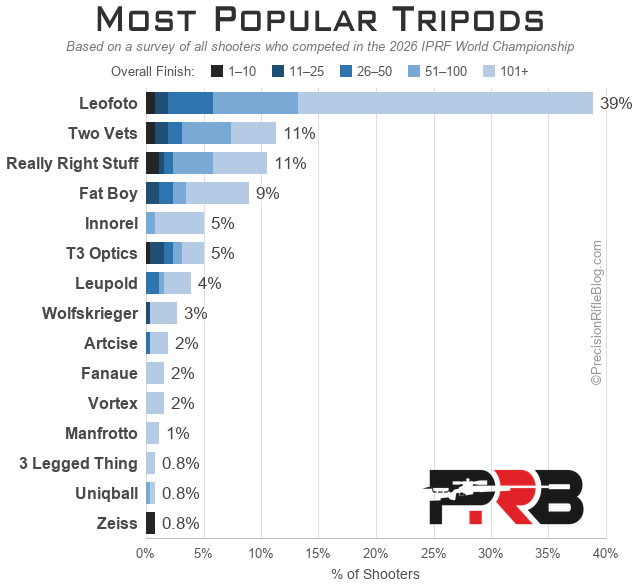
Leofoto was the most popular tripod brand at 39%. Two Vets and Really Right Stuff each rounded to 11%, followed by Fat Boy at 9%. Innorel and T3 Optics each accounted for 5%.
Leofoto’s share was more than 3 times that of the next brand. The Leofoto Juggernaut product line was designed and developed with the help of Morgun King (finished 7th in the Open Division) and Jon Pynch, both highly accomplished competitive shooters. The diameter of the carbon fiber legs is massive, and they are an incredible option for shooters who prioritize stability over weight and size. Watch Morgun King explain the Leofoto Juggernaut tripods in detail.
Two Vets’ QDT V2 takes a speed-focused approach with two leg sections and one twist lock per leg. That kind of design is popular among shooters across multiple brands. Fewer locks simplify deployment and reduce the number of “knuckles” you might have to deal with on the clock. The tradeoff is a longer collapsed package.
Really Right Stuff’s Versa-22i Inverted Tripod with the Anvil-30 ARC head is a very popular option for precision rifle competitions, combining an incredibly stable lever-operated ball head with very strong carbon-fiber, two-section legs.
The chart excludes 13 tripod brands that each accounted for 1 shooter each, simply to help the chart be more repeatable. However, all brands are listed below. A few of these brands were written in by the person taking the survey, so I only have the name or details they provided.
All tripod brands: Leofoto, Two Vets, Really Right Stuff, Fat Boy, Innorel, T3 Optics, Leupold, Wolfskrieger, Artcise, Fanaue, Vortex, Manfrotto, 3 Legged Thing, Uniqball, Zeiss, Benro, BOG, Brownells, Evumo, G-parts, Maestro Precision, PRS (write-in), RF Tactical, Sirui, Spartan, Sunwayfoto, Temu (brand unspecified), The Q.D.T LS, Ulfhednar, YGG
Binoculars and Spotting Scopes
At a precision rifle match, you can spend far more time spotting for other shooters in your squad than shooting yourself. Over a full day of competition, that adds up to a lot of time behind binoculars or a spotting scope. That’s why we asked each shooter, “What binoculars or spotting scope do you primarily use?”
This survey question combined binoculars and spotting scopes, so the chart represents the brand of observation optic a shooter listed.
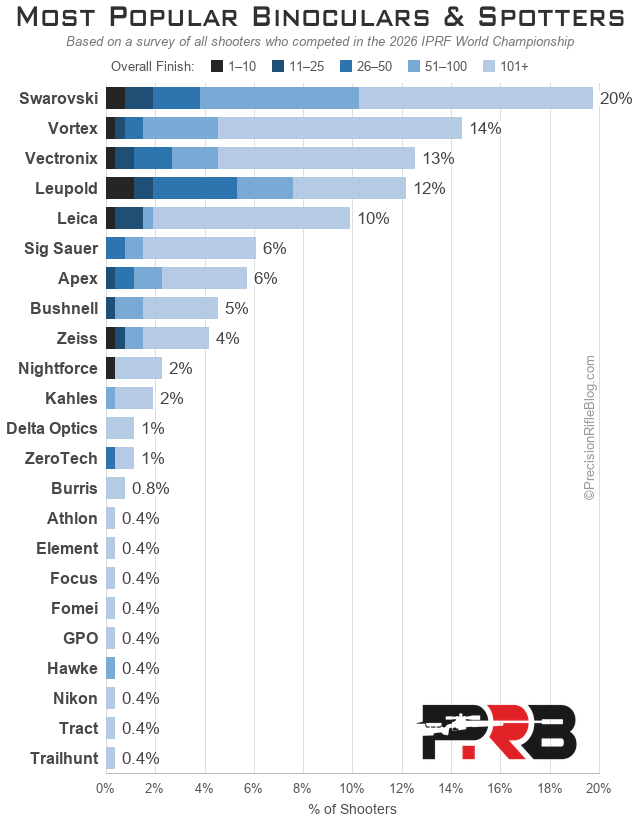
Swarovski led the binocular and spotting scope responses at 20%. Vortex followed at 14%, Vectronix at 13%, Leupold at 12%, and Leica at 10%.
Swarovski’s SLC 15×56 and NL Pure 14×52 are very popular options among competitive shooters. The higher magnification, combined with ridiculous optical clarity, is useful when watching a target and the surrounding terrain for wind clues or bullet splash.
Vortex’s Razor UHD 18×56 offers higher-magnification observation, while Leupold offers the tripod-compatible BX-5 Santiam HD 15×56. With either of those higher-power binoculars, a steady support becomes especially valuable.
Vectronix and Leica also offer products that combine observation with ranging. The Vectronix VECTOR X includes an etched reticle, laser rangefinder, and Applied Ballistics Elite solver. The Vectronix Vector X 12×42 can be paired with their 40% range extenders to give you 17x magnification. Leica’s Geovid Pro family combines binoculars and a rangefinder with Applied Ballistics support. Those are useful examples of the different jobs an observation optic can perform: watching impacts, measuring distance, and, with some models, generating a firing solution.
Among those who finished in the top 10, Leupold was used by 30%, followed by Swarovski at 20%. The remaining 50% was split evenly across five other brands. The spread in this category seems to be wider than others.
Bullet Brands
Now lets look at the ammo these guys were running at the IPRF World Championship, starting with bullets.
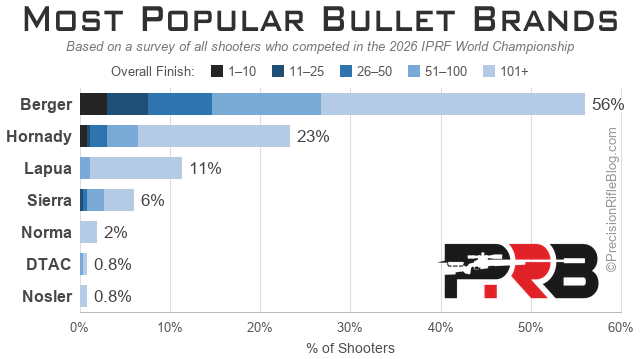
Berger bullets were used by 56% of the shooters. Hornady followed at 23%, Lapua at 11%, and Sierra at 6%.
Berger’s share was higher among the top finishers across all of the divisions: 80% of the top 10 and 83% of the surveyed shooters in the top 25 used Berger. Hornady accounted for the remaining 20% in the top 10.
Berger’s share exceeded all other bullet brands combined. Its Hybrid and Long-Range Hybrid Target families are built around low-drag designs, with the LRHT line adding a process intended to make bullet tips more uniform for less than 1% BC variation. Consistency matters here: a high ballistic coefficient is only part of the equation if drag varies from shot to shot.
Hornady offers both ELD Match and A-Tip match bullets. The A-Tip uses a machined aluminum tip and is packaged in production sequence to preserve consistency within a box.
Lapua’s Scenar family is another established match option, using an open-tip, boat-tail design across multiple calibers.
There did seem to be some significant variation in bullet choice based on where the shooter was from, which was worth noting. 80% of U.S. shooters used Berger, compared with 53% of international shooters.
All bullet brands: Berger, Hornady, Lapua, Sierra, Norma, DTAC, Nosler.
Read more: More on long-range bullet choices
Brass Brands
Now let’s look at the brands of brass cases that these competitors were running:
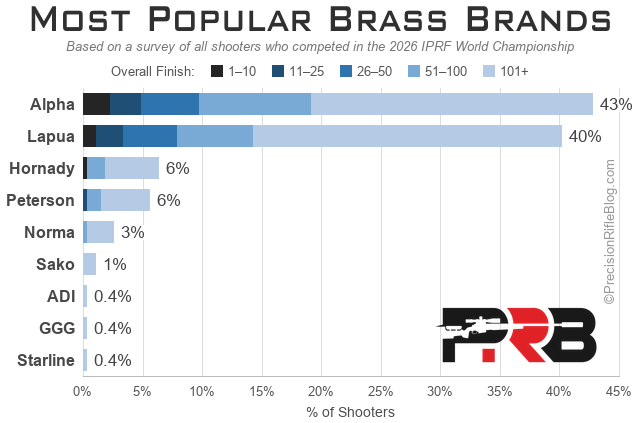
Alpha and Lapua were close at the top of the brass chart at 43% and 40%, respectively. Together, they accounted for 83% of the shooters. Hornady and Peterson each rounded to 6%, followed by Norma at 3%.
Alpha’s product line is closely aligned with this sport, including purpose-made cases for cartridges such as the 6mm Dasher, 6 BRA, 6 GT, 25×47 Lapua, and, of course, the Creedmoor cases. For a Dasher shooter, buying a case already formed to the cartridge saves the work of turning a BR case into one. Alpha manufactures cases using modern equipment, with advanced inspection and control of case dimensions built into the process.
Lapua has a long history in precision shooting, and supplies match brass for cartridges such as 6mm BR, 6.5×47 Lapua, and 6.5 Creedmoor. Its share trailed Alpha by only 3%, making this a close contest between two major suppliers.
Among the top 10 overall, 60% used Alpha, 30% used Lapua, and 10% used Hornady.
All brass brands: Alpha, Lapua, Hornady, Peterson, Norma, Sako, ADI, GGG, Starline.
Read more: More on competition rifle brass
Powder Brands
Now let’s turn to what gun powder shooters who reload said they use. Only 6 of the 266 surveyed competitors said they didn’t reload, and they were excluded from the chart below.
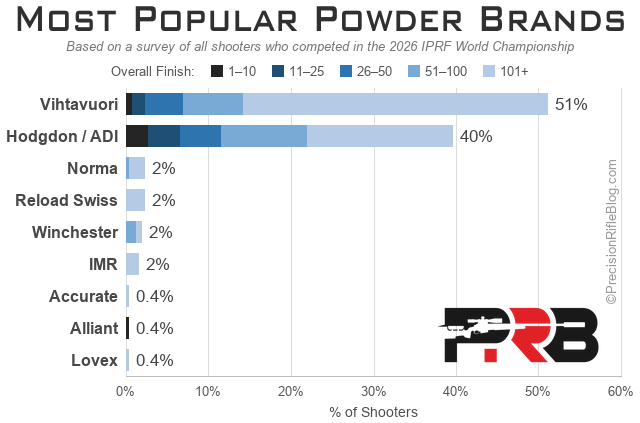
Vihtavuori was used by 51% of the shooters who specified a powder brand. Hodgdon and ADI answers are grouped together in this chart, accounting for another 40%.
Vihtavuori is a Finnish powder manufacturer with a broad following in the competition world. Vihtavuori highlights temperature stability and an anti-coppering additive in their powders like N150. Those features address practical concerns for competitors who want predictable velocity as conditions change and manageable barrel fouling.
| ADI Powder | Hodgdon Name |
| Trail Boss | Trail Boss |
| AR2207 | H4198 |
| AR2219 | H322 |
| BM2 | Benchmark |
| Bench Mark 8208 | 8208 XBR |
| AR2206H | H4895 |
| AR2208 | Varget |
| AR2209 | H4350 |
| AR2213H / AR2213SC | H4831 / H4831SC |
| AR2217 | H1000 |
| AR2225 | Retumbo |
| AR2218 | H50BMG |
Why group Hodgdon and ADI together? ADI manufactures several powders in Australia that Hodgdon sells under different names in the US. The table shown is ADI’s own equivalence table. That relationship applies to those products, and doesn’t mean that ADI makes every powder with a Hodgdon label.
Powder was another component that varied quite a bit depending on where the shooter was from. The second powder chart below separates Team USA from the other countries. Each bar still shows a share of all powder responses; the colors identify which group those shooters came from. Team USA contributed 12% of these responses, while other countries contributed 88%.
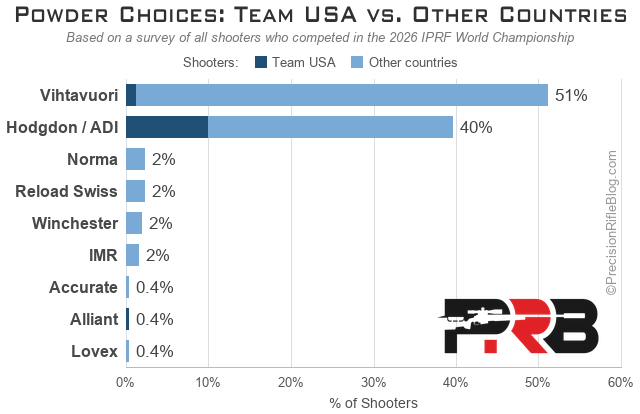
87% of U.S. shooters chose Hodgdon, 10% chose Vihtavuori, and 3% chose Alliant. Among shooters from other countries, 57% chose Vihtavuori, and 33% chose Hodgdon or ADI. The survey establishes those choices, but it does not tell us how much of the country-to-country difference comes from availability, price, or personal preference.
Among the top 10 overall, 70% used Hodgdon / ADI, 20% used Vihtavuori, and 10% used Alliant.
All powder brands: Vihtavuori, Hodgdon / ADI, Norma, Reload Swiss, Winchester, IMR, Accurate, Alliant, Lovex.
Read more: More on rifle powder choices | Powder Temperature Sensitivity: The Hidden Factor Affecting Your Long-Range Accuracy
Calculating Ballistics During a Match
Next, I asked the shooters how they calculated their ballistics during a match.
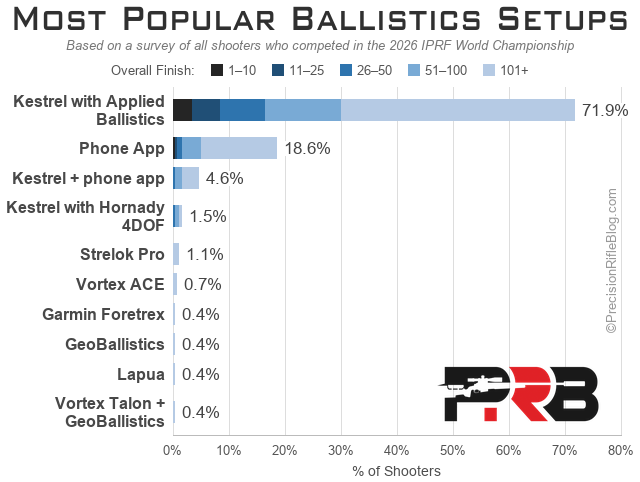
A Kestrel Ballistic Weather Meter with Applied Ballistics was the most common tool for calculating a firing solution during a match, with 71% of shooters using one. Another 5% described using a Kestrel for environmental readings with a phone app for the calculation, while 2% listed a Kestrel with Hornady 4DOF.
Among those who finished the highest overall, 90% of the top 10 and 92% of the top 25 listed a Kestrel with Applied Ballistics.
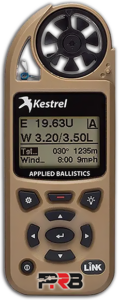
The Kestrel’s appeal is having the weather measurements and ballistics solver in one handheld device. Models such as the 5700 Elite measure local conditions and feed them directly into Applied Ballistics, with custom drag models available in the Elite solver. That reduces the amount of information a shooter has to transfer between devices. You still have to judge what the wind is doing downrange, but the unit handles the atmospheric inputs and trajectory calculation in one place. With more than twice the share of all other answers combined, it was the clear standard in this field.
Another benefit worth mentioning is the Kestrel 5700 Elite’s Target Card feature, which can be especially useful for competitive shooters. You can basically save up to 30 separate stages, with up to 10 targets each. So the night before the match, shooters can use the match book to prepopulate target distances for all of the stages. Then, during the match, they can pull up each stage’s dope using current conditions without having to re-enter every target distance. That can save time before a stage and potentially reduce data-entry errors.
Target Card is available on the 5700 Elite and 5700X Elite, both of which use Applied Ballistics. It isn’t available on the Kestrel with Hornady 4DOF or the standard 5700. I suspect the Kestrel with Hornady 4DOF might be more popular among competitive shooters if it offered that Target Card feature.
All ballistic calculator products: Kestrel with Applied Ballistics, Kestrel + phone app, Kestrel with Hornady 4DOF, Strelok Pro, Vortex ACE, Garmin Foretrex, GeoBallistics, Lapua, Vortex Talon + GeoBallistics
Read more: G1 BC vs G7 BC vs Bullet-Specific Drag Models
Phone Ballistics Apps
Here is how I asked this question: What phone app do you use most often for ballistics? (Regardless of whether you use it at a match or just ad hoc.)
51 of the 266 shooters said they never use a phone app to calculate ballistics, but the chart below shows the complete breakdown of the other 215 shooters who said they do use a phone app.
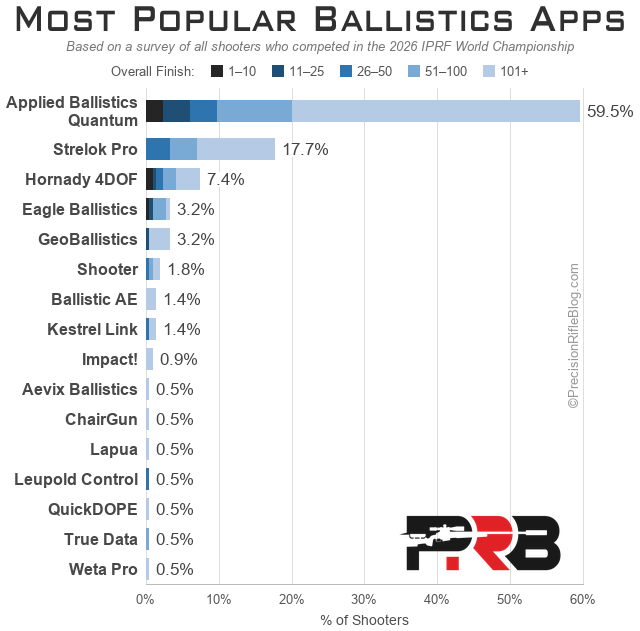
The phone-app question asked what shooters use if they ever calculate ballistics on a phone. Applied Ballistics Quantum led at 60% of app users. Strelok Pro followed at 18%, Hornady 4DOF at 7%, and Eagle Ballistics and GeoBallistics at 3% each. Shooter accounted for 2%.
Applied Ballistics Quantum was released less than 2 years ago, but it exceeded all the other apps combined! Its features include rifle-profile management, custom drag models, configurable target cards, and connections to a long list of compatible devices (Kestrel, Calypso wind sensor, rangefinders, etc.). That makes it useful for preparing and organizing match data, as well as calculating an individual shot.
Strelok Pro was the next most popular app at 18%. The original Strelok Pro app, developed by Igor Borisov, is no longer available through the main U.S. app stores. Apple & Google removed the app following U.S. government sanctions because the applications had reportedly been used by Russia’s forces in Ukraine. A separate app with a very similar name now exists, which makes this confusing. The “Strelok Pro–Ballistic Platform” app is NOT the same thing. It is not an update or continuation of the original app.
Hornady’s 4DOF app puts a sophisticated ballistic calculator on your phone that works even without cell service – AND IT’S FREE! Its solver uses Doppler-measured drag curves for a variety of supported bullets and even models the bullet’s angle of attack, so it can accurately account for effects such as spin drift and aerodynamic jump (the vertical shift caused by a crosswind).
What These Gear Choices Show
What stands out across most of these charts is how much the answer can change with the group you look at. Some categories were concentrated around a few brands, such as triggers and brass. Others, including optics and tripods, had a wider range of choices among the highest finishers. The U.S. and international comparisons also show why it is useful to look beyond one national competition circuit.
For someone putting together a precision rifle or deciding where to spend money on gear, these results provide a concrete list of products used at a demanding international match. The charts show popularity and who used each product. The feature comparisons linked throughout the article can help you decide which of those options fits how you shoot.
Which result surprised you most? Is there an international brand here you would like to learn more about? Leave a comment below.
Stay Up to Date
To be the first to know when the next article goes live, sign up for email notifications.
Follow on Instagram. Follow @PrecisionRifleBlog for more gear stats and match coverage.
Help Support Precision Rifle Blog
If you found this article helpful, here are a few ways you can help keep this kind of research going.
- Share it. Send the article to a shooting buddy, share it on social media, or post a link in a relevant discussion on your favorite shooting forum.
- Shop through PRB’s Amazon link. Using this Amazon link before you shop can earn PRB a small commission at no extra cost to you.
- Make a donation. If you would like to help fund more independent research and articles, you can donate to support Precision Rifle Blog. Thank you to everyone who helps make this work possible!