 PrecisionRifleBlog.com A DATA-DRIVEN Approach to Precision Rifles, Optics & Gear
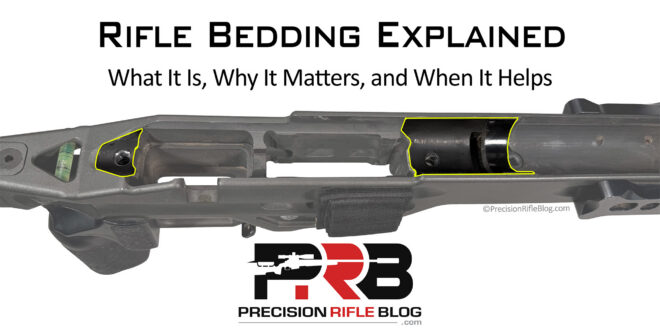
If you spend time around rifles, you’ll eventually hear someone mention “bedding the action.” It’s one of those topics that can sound mysterious at first, and the jargon around it can make a relatively simple concept sound more complicated than it is. My hope is this article can help explain it clearly and also provide direct insight from some of the best gunsmiths and precision rifle shooters in the world on the subject.
Most shooters assume bedding is about making a rifle shoot smaller groups. While that can be true, that’s only part of the story. At the highest levels of precision rifle shooting, bedding might be just as much about protecting your zero and ensuring consistency in real-world conditions as it is about improving precision.
In this article, I’ll walk through what bedding is, the different terms you might hear, along with insight directly from pro shooters and top gunsmiths on when it actually matters.

What is Rifle Bedding?
Rifle bedding is the process of creating a precise, stable interface between the rifle action and the stock or chassis. Most commonly, this is done using epoxy to form a perfectly matched surface so the action is fully supported and free of stress.
The goal is simple: Ensure the action sits in the exact same position every time, with even support and no unwanted pressure points.
If the action is only contacting the stock or chassis in a few spots, or if it’s being slightly twisted or stressed when the screws are tightened, that can lead to inconsistencies in how the rifle shoots.
Travis Stevens, owner of TS Customs and one of the top gunsmiths used by PRS Pro Shooters, told me this:
“Most receivers and chassis are not perfectly straight and square. Correctly bedding an action and chassis together can help alleviate the stresses that would otherwise be imparted on them when torqued together.” – Travis Stevens, Gunsmith & Pro PRS Shooter
Glass Bedding vs Epoxy Bedding
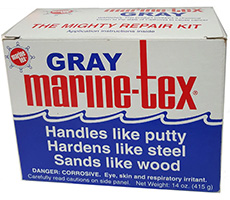
You may hear the term “glass bedding,” especially from older shooters or in hunting circles. Glass bedding is simply the older term for what we now call epoxy bedding. Early bedding compounds included fiberglass, which is where the name came from. Today, most modern bedding compounds are high-strength epoxy (like Gray Marine Tex or Devcon Steel Putty), but the purpose and process are the same.
What is Pillar Bedding?
“Pillar bedding” is another term that you may hear, but it isn’t an alternative to bedding; it’s an add-on. It involves installing aluminum pillars in stocks that don’t already have them, so the action screws tighten against metal rather than wood, polymer, or composite material (whatever the stock is made of). In most cases, a gunsmith will then epoxy bed the action on top of those pillars.
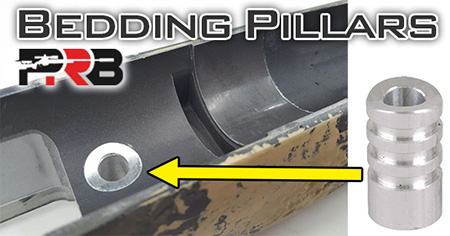
You don’t need to install pillars on aluminum rifle chassis, Foundation Stocks, or stocks with the Manners mini-chassis system, aluminum bedding blocks, or pre-installed pillars.
- Pillars = provide a consistent hard stop for action-screw torque and prevent stock compression
- Bedding = create perfect contact and eliminate stress
What is Skim Bedding?
Skim bedding is just a lighter version of full bedding. Instead of building up a full bedding surface (and potentially installing pillars), skim bedding uses a very thin layer of epoxy to refine an already good fit. This is often what is done on chassis and some high-end stocks that already have pillars installed. It’s typically done when the inlet is close to ideal, but you want to eliminate small gaps or stress points. Think of it as fine-tuning rather than rebuilding.
Why Bedding Can Improve Precision
Some rifles shoot great without bedding. Others show measurable improvement after being bedded. The difference comes down to how the action is supported.
If the action isn’t sitting evenly and stress-free, a few things can happen:
- The action can shift slightly under recoil
- Torque on the screws can introduce stress or distortion
Bedding helps by:
- Creating full, even contact between the action and stock
- Eliminating stress points
- Improving repeatability shot-to-shot
Bedding helps most when the action isn’t sitting evenly and stress-free. If everything is already aligned, repeatable, and torque-insensitive, you may not see a measurable gain.
Signs Your Rifle Might Benefit from Bedding
Not every rifle needs bedding, but there are some indicators that it might help:
- Inconsistent group sizes or random flyers that don’t have an obvious cause
- Point of impact shifts after removing and reinstalling the action
- Sensitivity to torque changes on the action screws
- Visible uneven contact in the inlet (shiny spots or gaps)
- Binding or movement as the screws are tightened
Stocks vs Chassis: Does Bedding Matter More?
Wood Stocks
Traditional wood stocks are the most likely to benefit from bedding (and pillars). Wood expands and contracts with humidity and temperature, which can introduce movement and inconsistency over time. Bedding a wood stock stabilizes the action, prevents compression, and helps maintain consistent precision across changing conditions.
Composite Stocks (Manners, McMillan)
Modern composite stocks are much more stable than wood, but they’re not perfect. Even high-end stocks can have slight inconsistencies in the inlet, minor misalignment, or uneven contact surfaces. That’s why bedding these stocks is considered a best practice by top-tier gunsmiths.

Do I Need to Bed a Chassis?
Aluminum chassis systems are typically machined to tight tolerances and may provide a consistent interface right out of the box, so bedding may provide less of a benefit. Some stock manufacturers offer v-blocks or mini-chassis systems integrated into their stocks, which would basically fall into this same category.
However, as Travis Stevens from TS Customs said, “Most receivers and chassis are not perfectly straight and square.” Some chassis are closer to perfectly straight and square than others. But even if the chassis is perfectly straight, is your action also perfectly straight? What are the odds that both the action and the chassis are perfectly straight and square? That is why many of the top gunsmiths might recommend bedding some brands and models of chassis.
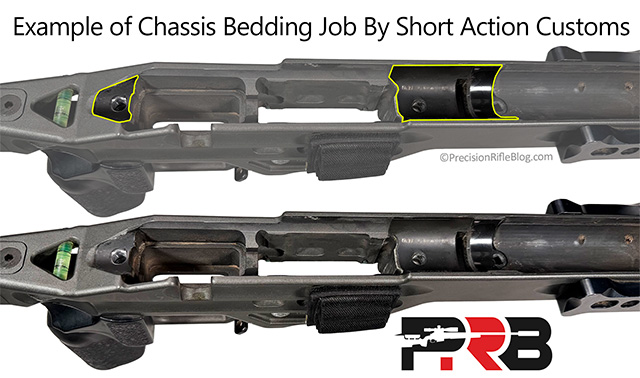
When bedding a chassis, some gunsmiths will only bed the front of the action (around the recoil lug) and rear/tang of the action. The photo below shows a chassis that was bedded by Short Action Customs with that approach.
Why Some Pro Shooters Bed Their Rifles
While bedding can improve precision, that’s not the primary reason many top shooters choose to do it. One of the top gunsmiths used by elite PRS shooters, Chad Heckler of 5×5 Precision, explained it this way:
“While it is true that most modern rifle chassis do not ‘need’ to be bedded, a good stress-free bedding job is like an insurance policy for your rifle’s zero.” – Chad Heckler
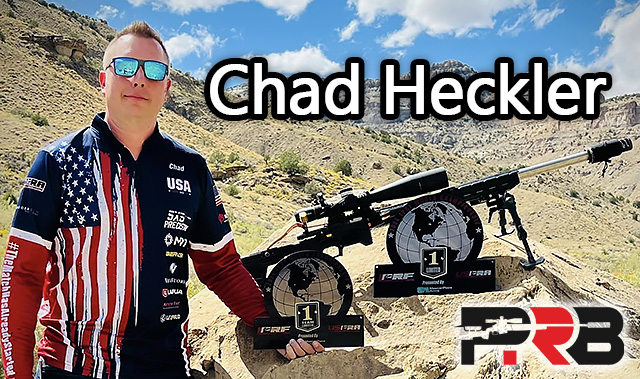
Chad is not only a respected gunsmith but also a PRS pro shooter, IPRF Limited Division World Champion, AG Cup Champion, and co-host of the Miles To Matches podcast. The dude knows what he’s talking about! His point is that while a chassis may perform well without bedding, adding a stress-free interface helps ensure nothing shifts if the rifle takes a bump or you accidentally hit the barrel on a prop.
In a rifle match, your rifle is regularly bumped as you move it under time pressure in and out of awkward positions like windows and cattle gates. What if a shooter dinged their barrel on a prop, or their rifle was accidentally tipped over near the firing line? They might instantly think, “I sure hope I didn’t just lose my zero because of that.” Proper bedding may reduce one possible source of zero movement and give them a little added peace of mind in those situations.
I’ve heard a few pros sum it up like this: “A good bedding job might not help, but it also probably won’t hurt – and it could help in those extreme cases where the rifle was banged around.”
To be clear, several other factors can cause your point of impact to shift from zero, including the scope, rings, muzzle device, action screws, and more. Bedding doesn’t make a rifle system impact-proof and can’t prevent zero changes caused by those other factors. Bedding can simply reduce the chance of a zero change from movement in the action-to-stock interface.
One way I’ve tested this in the past is to go to the zero range and get a perfect zero over 10 shots. Next, I’d take a rubber mallet and hit the end of my muzzle a few times. Then I’d fire 5-10 shots to see if my zero changed. Next, I might strike the side of the barrel a few times and fire another 5-10 shots. If my zero was largely the same across all 3 groups, then I typically don’t think bedding is necessary. Experience has taught me that it’s better to test things like that yourself and know exactly how your rifle will respond than to find out the hard way when it matters most.
I admit that is a very crude test. If you know a better way to test this, I’d love to hear about it. Please share it in the comments!
What the Data Says: Do Pro Shooters Bed Their Rifles?
This isn’t just theoretical! I personally surveyed the 200 top-ranked shooters in the PRS, so let’s look at what top shooters are actually doing.
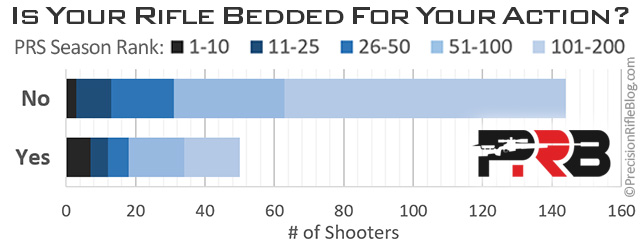
On the chart above, the various colors represent where a shooter landed in terms of season rank in the PRS. For example, black indicates shooters who finished in the top 10, the darkest blue is people who finished 11-25, and the lighter the blue, the further out they finished in overall standings. The chart legend itemizes the ranks each color represents, but basically, the darker the color, the higher the shooter’s overall ranking.
From this data, you can see the majority of pros don’t bed their rifles – but a meaningful portion do. In fact, 7 out of the top 10 bedded their rifles. That includes some using modern chassis systems that are marketed as “drop-in” solutions that the manufacturer says “don’t need bedding.”
The takeaway isn’t that bedding is required, but that some of the best shooters in the world still see value in eliminating every possible variable. If you are just plinking at the range as a hobby, don’t worry about it! If you’re trying to compete or going on a once-in-a-lifetime hunt, maybe consider it.
The data seems to suggest that pros believe some chassis or stock brands need bedding more than others. But which ones? I wanted to break down the data to provide as much insight from the pros as I can.
Some stock and chassis systems are bedded more frequently than others. That doesn’t necessarily mean one brand is “better” or “worse,” but it can give you insight into how often shooters feel the need to refine the action interface.
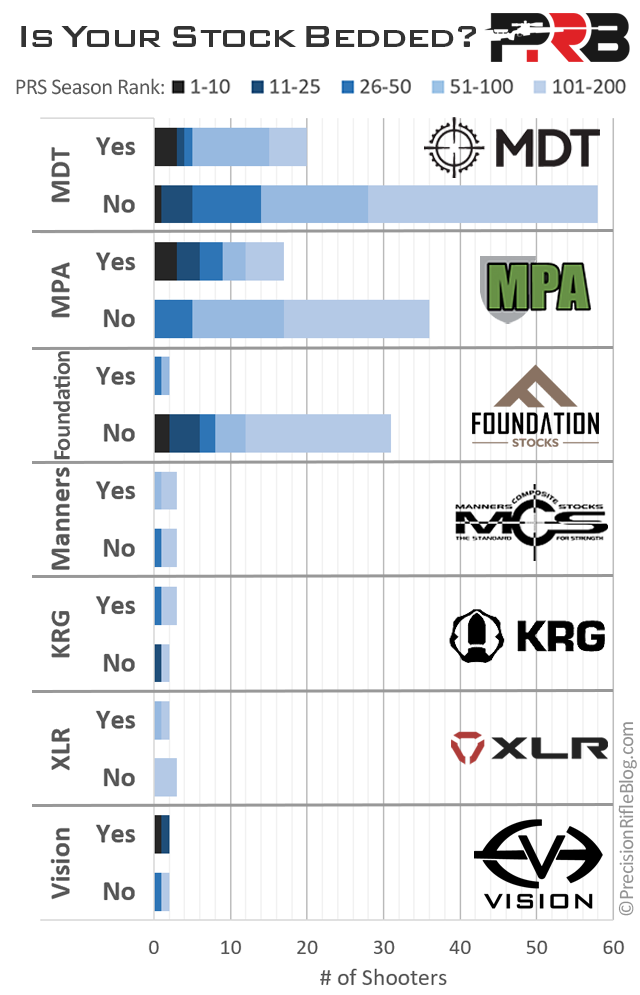
I like how the visual above shows you how small the sample sizes are for a few of the brands. For example, the Vision Pro Chassis was used by only 4 shooters in total. 2 of those shooters bedded their Vision chassis, and 2 didn’t. Interestingly, the 2 shooters who did were also the two highest-ranked Vision users: one finished in the top 10 and the other 11–25.
Below is another view of that same data, which is a little clearer by brand (but keep in mind the bottom half is based on small sample sizes):
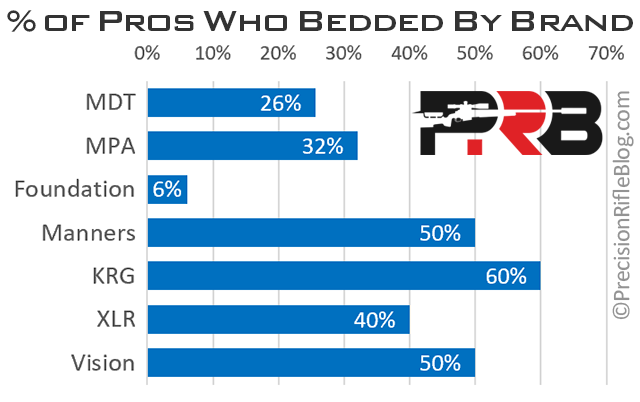
This can be helpful in a practical way:
- If most shooters running your brand are bedding it, it might be worth considering
- If very few are bedding it, you can probably run it with confidence as-is
Why Are Foundation Stocks Rarely Bedded?
It’s interesting to see Foundation Stocks well below the other brands, but not surprising. Most brands cut the inlet on their stock/chassis for a generic “Remington 700 footprint,” but Foundation machines each stock from a solid block of micarta and precision-cuts the inlet for a specific model action. When ordering, you select an Impact Precision, Lone Peak Fuzion, Defiance Ruckus, or another specific action—not simply a “Remington 700 clone.” That action-specific fit is intended to provide the close, consistent interface bedding normally creates, which is why Foundation Stocks and most gunsmiths say bedding isn’t necessary. Over 90% of these pro shooters chose not to bed their Foundation, including all eight who finished in the top 40.

Is There a Downside to Bedding?
Bedding is essentially irreversible without re-machining, so you’re committing that stock to that specific action. If you own a few brands of actions that you like to swap around, bedding will limit your flexibility.
Bedding is a common DIY project, and detail-oriented people have done it successfully simply by watching online videos. I’ve done it 3 times myself with good results, and I’m not a gunsmith. However, it requires care, can be messy, and mistakes can be difficult to fix cleanly. If done poorly, bedding can introduce stress or misalignment and actually hurt precision rather than help. Clearances related to the trigger, magazine, and action screws are critical. The recoil lug must be seated correctly. If you forget a step, your action could be permanently attached to that stock or chassis. I suspect having a gunsmith repair a bedding job gone wrong could be quite expensive.
If that sounds daunting, simply pay a gunsmith to do it. It will add some cost and extend turnaround time, but you’ll know it was done right. To find a great gunsmith who can do a world-class bedding job, check out this article: Top Rifle Gunsmiths: What the Pros Use.
Final Thoughts
Rifle bedding isn’t a cure-all, but it’s a proven way to improve consistency when the action-to-stock interface isn’t ideal.
For some shooters, that shows up as improved precision. But for many at the highest levels, the bigger benefit is confidence, knowing that their rifle will hold zero even after being pushed hard in real-world conditions.
At the end of the day, bedding is about reducing variables. In precision rifle shooting, fewer variables typically lead to greater consistency and better performance.



Great article, as usual. My experience reflects what your research has shown – timber stocks are most likely to benefit from bedding. I have done a few bedding jobs and noticed improved accuracy. I have also seen questionable bedding jobs that I needed to rectify – for example actions screws touching the hole through the stock, meaning they are tacking some of the recoil.
Thanks, David. Bedding has certainly helped a lot of rifles in wood stocks. The old man that taught me how to hunt and reload always swore by rifles that were “glass bedded.” He had done a few, and it gave him so much more confidence in them. I think it even helped when you’d go hunting in different environments, either humid/dry or hot/cold. It’d help stabalize that wood in those varying conditions, which would make the rifle shoot to a more similar point of impact. And for those it also helped the group size tremendously. He had meticulously cataloged so many loads and groups over the years, and you could clearly see groups shrink after he bedded a wood stock. Many of them were cut in half. Now, they were factory Remington and Winchester rifles, so they weren’t shooting bugholes to begin with! But it seems like it would get a rifle shooting 2″ or 2.5″ at 100 yards down to 1″. If a rifle was shooting 1.5″ groups before, it might get it to 0.75″. He wasn’t doing large sample size groups, but it didn’t take a statistician to see that there was a big difference! 😉
When it’s a wood stock, I think a good bedding job certainly has the chance for measureable improvement. When it comes to composite stocks or chassis, it’s not as clear. It might, but it might not. The truth is, the rifles we have these days are already so good. There are factory rifles that come with 1 MOA gaurantees. If the rifle is already shooting under 1 MOA, the big factors that affect precision have likely already been sorted out. We’d all love to find something that would make a 0.75 MOA rifle into 0.35 MOA rifle, but there probably isn’t any one thing that could do that … including bedding. I know I thought about bedding like that for a long time. That is why I have the photo of the chassis bedded by Short Action Customs in that article. That was my competition chassis, and I was hoping that by paying them to bed it I might get a little tighter groups. But it didn’t help. The truth was, I was already firing 0.4-0.5 MOA groups out of that rifle, both before and after bedding it.
It’s crazy how far rifles have come over the years! I’ve been hard into precision rifle and long range shooting since 2012, and hunted for 10-15 years before that. It’s nuts how great our equipment and ammo have become over the past 10 years. What a fun time to be doing this sport!
Thanks for the feedback! Best of luck to you.
Cal
One other thing to consider is that the mass of the rifle helps with regard to the need for bedding. Typically, a competition rifle with a very heavy contour barrel, “tactical” or “faceted” action with integral scope rail, and a competition-specific chassis have enough mass to reduce the effects of recoil, shock, and vibration to the rifle system. This is helped further by using a modest cartridge typical of PRS competition. The above combined reduces the need for bedding in these systems and/or minimizes the gains from the process (typically).
The old saying is: “Mass equals consistency, consistency equals precision”
However, if you consider a magnum hunting rifle with a smaller contour barrel, large magnum cartridge, and components selected for reduced weight (especially the stock), there’s absolutely more need to remove all the vibration that you can (bedding) and allow the things that you can’t remove vibration from to free float (barrel).
Also, we see that certain combinations of components typically work better than others. Lone Peak actions have worked well in MDT chassis, but we had to bed an Impact 737 in a MDT Elite. This is no fault of MDT or Impact Precision, simply a mis-alignment or stacked tolerance of the two components. I’ve had a Solus custom build that suddenly stopped shooting when the customer switched to an XLR chassis. Again, no fault of either manufacturer, but several spoonfuls of epoxy (we use Marine-Tec) and accuracy returned. Our policy is that all conventional stocks get bedded (even those with internal chassis) and conventional chassis MIGHT need to be bedded. If absolute top-level accuracy is desired (and the selection of components promotes this goal), we always bed.
Those are GREAT tips. And they all make sense to me. I didn’t really think about the total rifle weight changing the benefit of bedding, but it does fit my experience.
And I agree with your point about the combination of components playing into it. The odds that both the chassis and the action are in perfect alignment with one another just don’t always work out. Like you said, it doesn’t even mean that one is systematically better than another. They are just different, and we are stacking tolerances.
I really appreciate you sharing your expertise!
Thanks,
Cal
I believe it is more important to bed your scope mounts to your rifle, and lap or bed the scope rings to the scope. This is what ensures rigidity and scope alignment to the barrel. I always do this and you would be surprised how much scope rails don`t match the barrel contour. Of course some actions have the Pic rail machined into the action for perfect alignment.
You want the bedding material to be on the bottom of the scope rail, so wax the barrel. torque the screws to spec, scrape or wipe off the excess that squeezes out with a plastic tool. For scope rings I only do the bottom half, the top half holds it there.
Very interesting! Thanks for sharing, Boyd. I’ve never done that, but I know that scope or ring movement is just as likely to move your zero as the action-to-stock interface moving. So really it’s a very similar argument for doing what you proposed as what the pros are talking about in this article.
I do personally run actions with integral rails, and I’d say that most other pro-level competitors do as well. That is just one more variable you can eliminate.
Honestly, I had that bite me on my first custom rifle. It was built on a Stiller Predator action, which is a steel action with a detachable aluminum rail. They used steel screws for the rail, and they eventually started eating into the rail, causing it to move very slightly (but randomly) under recoil. It was such a pain to diagnose because it was sporadic … and it was my first precision rifle, so I just kept blaming myself, or my reloads, for the random shifts in point of impact. I eventually complained enough to the gunsmith that he took a look at it and was shocked to find that. We had a custom steel rail made for it, and the problem 100% went away. It really was very painful to troubleshoot and literally took months.
I say all that because if I were using an action with a detachable rail, I would 100% follow your advice!
Thanks for sharing,
Cal
Cal, when I bed a rail or mount, I coat the underside of the mount with the compound, I also coat the screws with a release agent, because I push them through the compound in the holes in the mount and that pushes the compound into the clean holes in the barrel. When I tighten the screws, the compound squeezes up the gaps between the screw and the threaded hole in the barrel. This also beds the screws in the action with no tolerance left for movement. I have never had a scope shift and I am not easy on my rifles. I do bed actions too, but not on all of them. As long as my scope stays firmly in alignment with my barrel, I`m good.
I’ve built a number of stocks over the years, and on a wood stock, I feel pillars and bedding is mandatory. This is doubly true when you start hanging very heavy long barrels in them. On my Manners with the mini-chassis, I considered bedding, but the gun was already shooting.5″ or better, so it’s a wasted exercise. On the 2 aluminum chassis guns I have, I don’t feel there is any real gains to be made either. I’ve had friends ask me the same question, and my response is always ” Unless it’s wood, or composite without pillars or a bedding block, it’s largely not going to make that big of a difference”. Guys will still do it, because they want to remove every variable, but for 98% of shooters, just training more will have a larger benefit.
Corey, I agree with you 100%! Couldn’t agree more. There might be some edge cases or exceptions, but I think that is good advise for the overwhelming majority of cases.
Thanks for sharing,
Cal
Interesting article, and timing. I just bedded a Ruger Rimfire Precision for NRL22 last week, groups went down by a third.
That’s awesome!!! Nothing more satisfying than that! Thanks for sharing.
Another great article Cal along with some useful comments.
One thing I am curious about is whether those here did or did not bed their action had a mini-chassis. It’s obvious on a Foundation stock. But for example, Manners stocks when I purchased mine (I have 4) were available with or without pillars or mini-chassis. All of mine have mini-chassis which aren’t supposed to need bedding. And I haven’t seen the need to bed mine.
So, my question is did some of the pros bed their actions because they did not have mini-chassis? And vice versa?
Thanks for sharing your research.
Lee
Lee
Hey, Lee. I’d suspect that almost all of them that did bed a Manners Stock were using a stock that didn’t have the mini-chassis in it. That is just the traditional method. I didn’t specifically ask them if it had the mini chassis or not, so I can’t be sure … but based on my experience, I would think they either ordered it with the mini-chassis or ordered it without because they intended to bed it.
Thanks,
Cal