 PrecisionRifleBlog.com A DATA-DRIVEN Approach to Precision Rifles, Optics & Gear
Related Articles

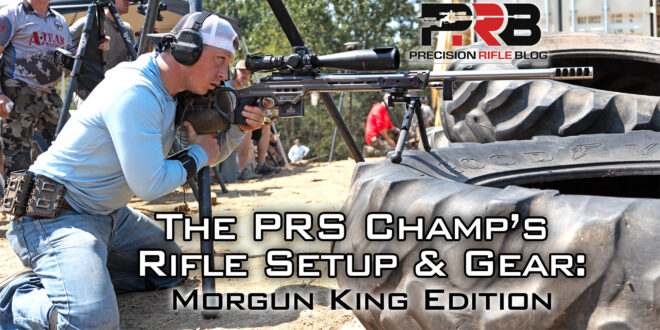
When someone rises to the top of the PRS season standings, shooters naturally want to know exactly what was behind that performance. Morgun King shared his complete rifle and gear setup with me before the 2025 PRS Finale, and his choices reveal a few surprises, including his philosophy on rifle balance and the factory ammo he trusted on his way to the title.
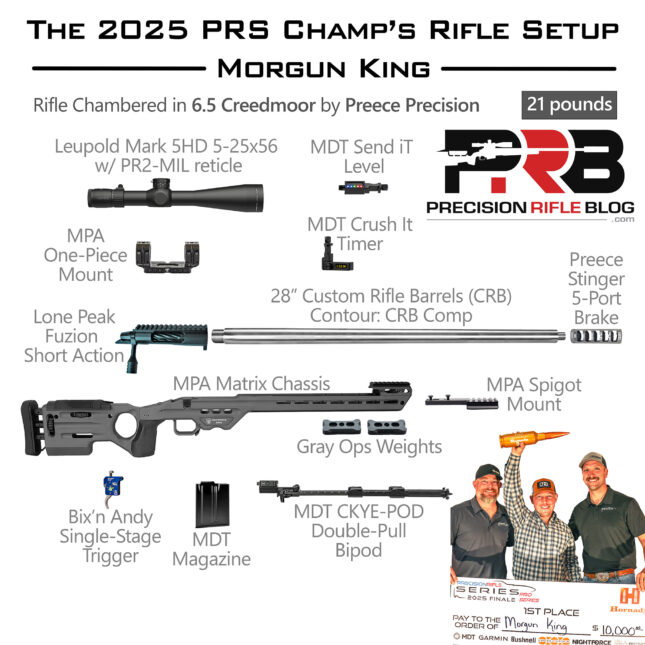
Before we dive into the deeper topics like balance point and ammo choice, let’s start with the foundation of Morgun’s system. Below is the complete breakdown of his rifle build and every accessory he ran recently at the 2025 PRS Finale, exactly as he listed it on my “What The Pros Use” survey:
- Cartridge: 6.5 Creedmoor (Read why Morgun prefers the 6.5 CM)
- Gunsmith: Preece Precision
- Action: Lone Peak Arms Fuzion Short Action (Is your action cut for AW magazines? Yes)
- Barrel: 28” Custom Rifle Barrels (CRB). Countor: CRB Competition Contour (The CRB Comp contour is slightly heavier than a standard MTU contour. It has a 1.25” diameter shank for 6” on the chamber size, and then tapers to 1.10” at the muzzle.)
- Stock/Chassis: Masterpiece Arms Matrix (The original Matrix, not the Matrix Pro. Is your chassis bedded for your action? Yes)
- Trigger: Bix’n Andy Single-Stage (set to 4 ounces)
- Scope: Leupold Mark 5HD 5-25×56 with PR2-MIL reticle
- Scope Mount: Masterpiece Arms One-Piece Mount
- Muzzle Brake: Preece Precision Stinger 5-Port (30 caliber)
- Suppressor: KGM R30 (30 caliber)
- Primary Magazine: MDT Magazine (The 6.5CM uses the same magazine as a 308, but MDT also offers 6BR-size magazines for the 6mm Dasher and 6mm BR sized cartridges)
- Do you use double-stack AW magazines in rifle matches? I sometimes use double-stack magazines on a stage when the compact size would help.
- Primary Bipod: MDT Ckye-Pod Double-Pull
- Anti-Cant Level: MDT LRA Send iT Electronic Level with Brandt Built Indicators on the scope ocular housing
- Timer: MDT Crush It Timer
Morgun’s Overall Rifle Weight & Balance Point
Morgun said the overall weight of his rifle is 21 pounds in “ready to fire configuration,” which includes scope, mount, and all attached accessories. However, Morgun’s primary concern regarding weight and barrel contour/length is the rifle’s balance point. Morgun believes the rifle’s balance point is critical.
Here is how Morgun described his view of a rifle’s balance point on Ep 17 of the Mythology of Marksmanship podcast:
Morgun: “I think a heavy gun that’s not balanced properly is almost as bad as a gun that weighs 10 pounds. Because it’s just cumbersome, and it doesn’t do its job well. I see a lot of guys running weight kits that you can put on the rear of the rifle, and I almost laugh at that. It’s like the worst thing you can do. There is a point where the balance point of your gun could be too far forward, but it’s harder to get that than it is to have a balance point too far back.
A lot of guys will put their hand under the mag well of the rifle, and if it balances there, they’ll say, “Oh yeah, it’s balanced perfectly.” I always laugh because that is not perfectly balanced. Maybe that would be perfect if you are taking offhand shots, but you need to set your gun up for the majority of our shots, which in the PRS are taken off a bag on a positional stage.
If you want the most effectively balanced rifle, I think you need to take whatever bag you’re shooting, and you need to put it on something, measure it, and then cut that measurement in half. So say your bag is 10” long and you cut that in half to get 5”. That’s the center of your bag. That’s the minimum distance your balance point needs to be away from the front of your mag well or wherever your gun begins contact with that bag. For me, it’s the front of the mag well.

I’d say an inch or two ahead of that minimum distance is even better. The reason is because then you’re using the weight of your rifle to mitigate muzzle jump. Because then it has to move the balance point before it can go up. Because if you’ve got that much weight out there, it’s really hard to move it up.
So if your bag is 10” long, your balance point needs to be between 5 and 6 inches forward of the mag well. If your bag is 8” long, the balance point should be between 4 and 5 inches. I think mine is usually balanced somewhere around 5 inches away from the magwell.
You want your rifle to sit right in the middle of the bag and for it to be neutral with its balance point. So that’s 4 to 5 inches, but having a front-heavy bias by an inch is a little bit better.
If you are a little less, you’re okay. It’s going to be fine. But, just know that it’s better to be in the middle or a little bit in front of that for mitigating muzzle jump. That extra inch in the balance point makes a huge difference. It makes a difference in the feel. It makes a difference in the wobble. It makes a difference in a lot of things that people don’t even realize until you shoot one, and then you’re like, “Wow! This gun just settles.” It’s because that gun just has no choice but to settle because it’s balanced properly.”
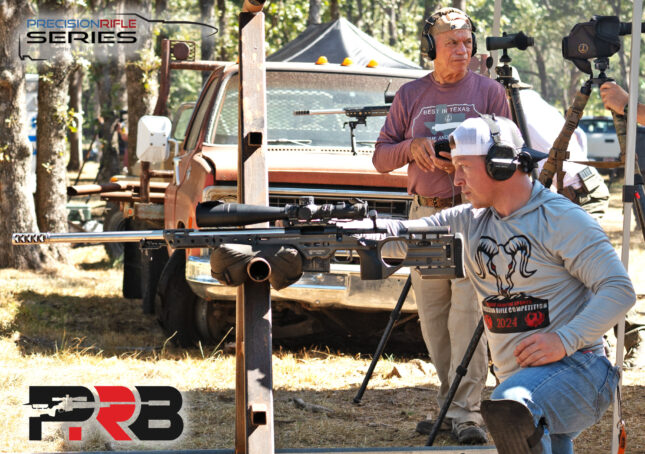
Morgun’s Match Ammo

Morgun King is the first PRS Season Champion who was using mass-produced factory ammo! Morgun used 6.5 Creedmoor ammunition manufactured by Eagle Eye Ammunition.
Eagle Eye ammo was also used to win the US Army Special Operations Command International Sniper Competition at Fort Bragg for the 3rd time this year! In fact, the owner of Eagle Eye told me over half the field at the USASOC International Sniper Competition were using ammo they made, including the top 4 teams! They manufacture ammo for the US Army Marksmanship Unit (USAMU), US Army National Guard Marksmanship Training Center, and other military groups both domestically and internationally. Adding a PRS Champion to that list is quite the resume!
Here are all the specs on the exact ammo that Morgun used to win the 2025 season:
- Cartridge: 6.5 Creedmoor (Read why Morgun prefers the 6.5 CM)
- Do you handload or use factory ammo for matches? I use factory match ammo.
- Ammo Company: Eagle Eye Ammunition
- Bullet: Berger 6.5mm 156 gr. EOL Elite Hunter
- Brass: Lapua 6.5 Creedmoor
- What is your average 5-shot group size? 0.3 MOA
- What is your average muzzle velocity? 2,670 fps
- What is the standard deviation (SD) of your muzzle velocity over 10 shots or more? 8 fps
To learn more about Eagle Eye Ammunition and the serious statistics they use to develop their loads, check out this article: Best Long Range Ammo for Those Not Reloading – What The Pros Use.
Here is an interesting fact on the calibers that each of the top 3 shooters for the 2025 PRS Season were using:
- Morgun King: 6.5 Creedmoor
- Austin Buschman: 6mm Dasher
- Clay Blackketter: 25×47 Lapua
#1, #2, and #3 were all using a different caliber! Clearly, any of those calibers is capable of world-class performance at long range.
If you are interested in learning more about the cartridges the top pros are using, this article has exhaustive details about it.
Other Gear
Here are the remaining details about Morgun’s gear that he shared on my “What The Pros Use” survey a few weeks ago:
- Primary Rear Bag: Armageddon Gear OG Game Changer
- Primary Positional Bag: Armageddon Gear Plus One Game Changer
- Plate Bag: Gray Ops Mini Plate PRO with Armageddon Gear Mini Plate Pad
- Ear Pro: Sordin Supreme Pro-X Electronic Earmuffs
- Tripod Brand: Leofoto
- What do you use to spot at most PRS matches? I carry Leupold BX-4 Range HD TBR/W 10×42 binoculars and a Leupold Mark 4 12-40×60 spotting scope
- What do you use to calculate your ballistics at a PRS match? Kestrel 5700 Elite Weather Meter with Applied Ballistics
- Which drag model do you use to calculate your ballistics? G7 BC
- What phone app do you use most often for ballistics? I never use a phone app to calculate ballistics.
Thanks, Morgun, for sharing all the details with the rest of us! It’s always fun to see exactly what the guy at the very top of the sport is using.
If you’d like to learn more from Morgun, I’d highly recommend his podcast, Mythology of Marksmanship, which now has over 50 episodes of outstanding content. I’ve personally listened to every one of them. In what other sport does the person at the very top of the podium share all of their thoughts on competing and tips for being successful?! That is one of the things that I love about this sport! 😉
To be the 1st to know when the next article goes live, sign up for email notifications:
Shop Using My Amazon Associates Link
If you buy stuff off Amazon, use the link below, and I get credit regardless of what you get or from what country you order – and you pay not a penny more! Amazon has an affiliate program that pays a small commission when readers use links from my website to buy stuff. You still get your stuff at Amazon’s great prices, and you can help support PRB at the same time.

Donate to PRB



I am not involved in these competitions and giving advice would be presumptuous, but a question. If the goal of finding the balance point on the rifle is to minimize muzzle jump, why not simply lash the fore end and barrel to the bag? It would anchor the rifle more securely to the support surface and the rifle would effectively be heavier and theoretically there would be less muzzle jump
That’s a great question, Warden. Some shooters (including me) often do attach a bag to the rifle. There are some who attach it to the rifle with Velcro straps, but I’d say what is more popular among the pros is to use an arca-clamp to attach the bag in a very rigid way to the bottom of the rifle’s forend. I personally do that on some stages where I feel like the time constraints are tight. I feel like it helps me move more efficiently from one prop or barricade to another, and it allows me to use both hands to carry and position the rifle instead of 1 hand holding the bag.
Here are the products that I use in that scenario: Area 419 Railchanger-X with the Armageddon Gear Schmedium Gamechanger Bag with Area 419’s Railchanger Panels.
But, there are several other products out there like the Gray Ops CNC Mini Plate Pro with the Armageddon Gear Mini Plate Pad. I also use that setup at times for other stage scenarios.
So, having said all that … I think that’s a good idea, although I’d still say that most pro shooters don’t attach a bag to their rifle at a match or do it very rarely. They probably move more efficiently than me with the bag, or just feel like attaching it adds unnecessary complexity. I’d say that kind of thing likely comes down to personal preference or strategy nuance.
However, I don’t add the bag to help with the balance point. When I attach the Schedium bag, I put it in the typical place where my bag would be under the forend, which is right in front of my magazine well. So adding the bag or not adding the bag doesn’t change my balance point at all.
I have seen pro shooters like Jake Schur who keep the Gray Ops CNC Mini Plate Pro with the AG Mini Plate Pad on the front of our rail when shooting prone stages, because when you have sand in that bag it weighs 4 pounds. That basically does what I feel like you’re suggesting here. Jake told me he does that to basically add weight to the front of the gun to offset muzzle rise a little bit, and if you aren’t moving around to props and it isn’t in the way of anything – then why not?
So, I think you’re on to something, and a few of us do something similar … but it’s a little different, too. We like the arca rail attachment because it keeps something from touching our barrel. We’re all pretty paranoid about anything that touches our barrel could change the point of impact, so I’d bet most of us might steer away from lashing anything that would contact the barrel directly. But, the idea you have is a good one – our implementation is just a little different.
And hey, just because you don’t do competitions doesn’t mean you might not come up with a good idea! 😉 Sometimes those of us in it every day get used to seeing something approached the same way, and so we might need a little inspiration from the outside occasionally. Anyone who heard about using a tripod for a rear support probably would have shot that idea down 10 years ago … but I’ll never forget the match when I saw someone use it for the first time! Brilliant! I’ve actually used it hunting now. With enough practice, that could be the most flexible thing you could do to get steady!
So I appreciate you dropping the comment!
Thanks,
Cal
Thanks Cal. I appreciate your considered response. It’s great to engage with people who are still engaged like that.
Warden
Probably 60 years ago my father-in-law built up a 25 Souper (25-308) on a Mauser 98 action. I enjoyed shooting it but didn’t reload in those days; so I gave it back and it was subsequently stolen from him. Years later, I got a M98 in 257 Roberts, and had it converted to a 25-06. The old 117-120 bullets worked well but weren’t heavy enough to tip over metal targets at distance. I haven’t tested it in awhile but I’m thinking of having this rifle rebarreled.
With the new heavier 25 cal bullets, what is the recommended twist?
I really enjoy your articles. I shot a PRS warmup match last year, and had a lot of fun. But it’s a younger man’s sport. I also shot my first 1000yd benchrest match . Both with a 6mmCM RPR.
Have a Merry Christmas. David
David, that is really cool. What is funny is that many of us pro shooters are trying out a 25×47 or 25 Creedmoor, which is EXTREMELY similar to the 25 Souper (25-308) you described. And your father-in-law was shooting that 60 years ago! Wow!
Most people use either a 1:7.5 or 1:8 twist in a 25-caliber barrel where they want to use those high-BC, heavy-for-caliber bullets, like the Berger 135 gr Long Range Hybrid Target. Honestly, either of those twist rates would work great for 99% of applications.
If you find yourself shooting in cold conditions (below 40 degrees) at low elevation (under 1000 feet), then I would go with the 1:7.5 twist. That will ensure you have a high enough stability factor to get the full BC of the bullet and it still be consistent. If you find yourself only shooting in warmer weather and at higher elevation, then someone could argue that the 1:8 would be a more optimal twist rate.
I personally would lean towards a 1:7.5 twist, but if they were out of that … I’d happily buy a 1:8. I don’t think anyone can “shoot between those numbers” in the real world. I’d say it is more of a theoretical or academic debate.
But, I certainly wouldn’t buy a barrel that had a twist rate that was slower than 1:8 (e.g., 1:9 or 1:10).
And thanks for the kind words about enjoying the articles. I appreciate you saying that. This is a labor of love for me. It’s hard to find the time to do it, but when guys like you chime in with comments like that it keeps me going! 😉
Merry Christmas,
Cal
This is the type of article that keeps bringing me back to Precision Rifle Blog. Not only is the information relevant and interesting, it is written well enough that I don’t get frustrated from bad grammar. Thanks Cal. If you want more interesting reading, try reading all the other articles here. It has helped my shooting and I’m sure it will help yours.
Thanks, Benjamin! I love that kind of feedback. Glad you’ve found the content so helpful.
Thanks,
Cal
THANKS VERY MUCH FOR YOUR EFFORTS! and Merry Christmas.
re guns/cartridges, I remember the old saw, beware the man with only one gun
Thank you, Don. And I agree with that saying. Pretty sure Morgun does, too! While lots of the pros have hopped between a few cartridges, I’m pretty sure Morgun was the OG when it comes to modern pros using a 6.5 CM. No frills for him … even using factory ammo!
He clearly knows how to use it!
Thanks,
Cal
So!……a great article has usually……..total cost of all the gear?……I suppose I could look it all up and do it but I’m lazy…..and 21 pound? Pick….maybe they should do a 10 mile road march and then shoot!….ah the good old days!…..take care and happy holidays….
Hey, Pierre. Thanks for dropping the comment. Glad you enjoyed it. I haven’t added it all up either, but I’d guess around $8,000 MSRP all in. It’s pretty much the best of the best on every component and the accessories add up quick!
And this definitely isn’t something you want to hike for with, although I’d bet there are some matches where we walk a few miles total with the rifle between stages over 2 or 3 days. The PRS did add the sportsman division in 2025, which limits the rifle weight and requires you to shoot a 6.5 CM. It seems like a lot more practical/hunting division. The winner of that division this year probably got more in prizes at the finale than Morgun did winning the open division, so it seems like they’re making a hard press to promote that. But the open division is still the most competitive by a long shot.
Happy Holidays!
Cal
Hey, Pierre. I looked it all up today, because I was curious if my original ballpark/gut estimate of $8k was close. It turned out to be $8,509 all-in for MSRP on all of the different items (before tax and shipping). That doesn’t include the suppressor, but Morgun typically runs a brake in PRS matches … so this is the way his rifle is typically setup.
MSRP Rifle Component
$1,450 Lone Peak Fuzion Short Action
$840 Chambered CRB Barrel from Preece Precision
$1,350 MPA Matrix Chassis
$375 Bix’n Andy TacSport Pro-X Trigger
$2,200 Leupold Mark 5HD 5-25×56 with PR2-MIL reticle
$275 Masterpiece Arms One-Piece Scope Mount
$430 Preece Precision Stinger 5-Port Brake
$80 MDT Magazine
$800 MDT CKYE-POD Double-Pull Bipod
$230 MDT Send It Electronic Level
$95 Brandt Built Ocular Housing Anti Cant Indicators
$250 MDT Crush It Timer
$72 Gray Ops Weights Long Pair (2)
$62 Gray Ops Weights Short Pair (2)
$8,509 Total MSRP Before Taxes & Shipping
I knew that all of the accessories would add up quick!
I did notice that EuroOptic.com has the chassis for $200 off right now, and you might be able to find deals on some of the other items, but this reflects what MSRP was on 12/8/2025.
I should have anticipated that question and included it in the original article. As soon as you asked it, I started wondering myself! 😉
Thanks,
Cal
Thank you sir!…..In another area, and way off subject, has anyone done a thermal study on the fluting of rifle barrels? In so much has it being effective? How does it affect barrel stiffness, harmonics, accuracy, etc…….I am watching a course on thermodynamics so it all popped in my head on how it all applies to rifles…..this I am sure applies to you “hot” weather guys……I have a fluke thermal device for my phone that I may try to see what happens when my boy shoot this winter just to check it out…..anyway happy holidays and take care…..
Hey, Pierre. I haven’t seen any serious studies on fluting, but there might be some out there. Maybe someone else reading the comments will chime in and share one.
Thanks,
Cal
Thank you. That graphic with all his gear labeled and pictured was excellent!
Thanks, Brandon. That took a while to put together, but it’s how I like to see it. It really helps you see everything at a glance.
Thanks for taking the time to say that. That feedback is enough for me to continue to invest the time to make graphics like that in the future.
Thanks,
Cal
Hi Cal:
For Morgun using mass-produced factory ammo to pull this off is simply unbelievable. I would never have believed it was possible until I read all about the ammunition manufactured by Eagle Eye Ammunition.
Eagle Eye wrote “Our Precision Match ammunition is factory tested to ensure every lot shoots 1/2 minute of angle or better. We also velocity and trajectory match every lot to ensure unrivaled consistency. ” That one statement alone is so much better than all the manufactures I get to buy from.
I am a 6.5 CM guy so I am trilled Morgun won using this caliber.
The article also went into great detail about “rifle’s balance point”. It left nothing for you to guess about and this was a very important part of the article.
Thanks for another great article Cal.
Paul Goggan
Paul, I 100% agree. I thought it was unbelievable too, until back in July. That’s when I reached out to Eagle Eye as I was writing this article: Best Long Range Ammo for Those Not Reloading – What The Pros Use. I ended up talking to Justin Brown (Eagle Eye CEO) and he shared a lot of very interesting information about their ammo performance. Justin has a Ph. D. and brought a very heavy statistics background that he’d used in the medical field to ammo manufacturing. Here is a quote from our conversation:
They did “design and engineer our loading machinery from a completely blank sheet of paper, specifically for manufacturing long-range precision ammunition.” But, it is still, in his words, “mass-produced factory ammo.” Honestly, I have about 50 boxes of Eagle Eye 223 ammo in my safe that a friend left me when he passed away, but I didn’t really know anything about that brand. It turns out that is amazing ammo!
And I’m glad you enjoyed the balance point content. All of that came from a podcast that I listened to back in 2022! I still think it was one of the best descriptions of balance point for PRS shooting that I’ve ever heard, which is why I still remember it and think back to it occasionally. I figured most people wouldn’t have context for why he’d use a 21 pound rifle, or they’d just think he was one of the “Barricade Benchrest” guys. But on that same podcast he was using a 19 pound rifle at the time, and he said his rifle is the absolute lightest he can make it and still get it to balance correctly. It’s really hard to get your balance point out in front of the action that far. The weight of the rifle adds inertia, which helps the rifle resist movement … but balance point is really what most of these guys are thinking when they decide barrel length and contour, and it is the biggest driver behind the overall weight of the rifle. There are a few pros that add weights for more than just balance, and they might want their rifle to weigh 26-29 pounds … but that doesn’t represent what most of us are going for.
I’m actually planning to run a suppressor with a brake on it during the 2026 PRS Season (the SilencerCo SCYTHE Ti with the Recoil X Gen 2 Brake). I’m excited because that will add a little more weight to the muzzle of my rifle, and I think I’ll be able to reduce the weight a little and still have the perfect balance point. But, again … it is the balance point that is driving the weight of my rifle more than wanting it to weigh a lot. So I 100% agree with Morgun. I’d say it represents how most pros think about this, and Morgun did a good job explaining it.
Glad you enjoyed the article! Thanks for taking the time to share that.
Thanks,
Cal
In my hunting rifles I always preferred slightly front heavy rifle…..they seemed (for me) to stay on target better and my old hunting buddy noticed it stayed on target nicely….we also were “open sight” hunters for the most part with moose and when going for caribou my scopes were 2 to 7 power and he had a fixed 4 power….I also had Douglas barrels that were medium spotter so that is what gave it the forward heavy and it just worked out to be synergy when it was all put together….
Excellent article as always. That hefty barrel sure tames a 6.5CM better then a M24/M40 profile.
I looked up the ammo he is using. Its $290 per box of 100 (assuming 3k rds per season (probably more rds for him) we are at $8700 or $2.90 per/rd for the ammo (no tax and shipping incl). If you would load that ammo yourself here’s the breakdown bellow.
Berger Bullets 156gn – $1950 for 3k
New Lapua Brass – 500 pcs (fired 6 times) – $650
Powder H4350 – 41gn per charge or 123000 grains = 15lbs at $50 = $750
Primers CCI – 3k primers at $100/per 1k = $300
Reloading time invested – Priceless (for everything else there’s Master Card at 29.9% APR) LOL
Total components cost: $3650 or $1.22 per round
Shoot responsibly.
Thanks, Joe. I appreciate you looking that up and sharing.
I think Morgun would say that the only thing you didn’t include would be the cost of the time spent reloading. I did what I believe to be the most honest and comprehensive breakdown of the total cost and accounting for the reloading versus buying factory ammo in a recent article: Best Long Range Ammo for Those Not Reloading – What The Pros Use.
I realize some people enjoy reloading and see time spent doing that as part of the hobby of long range shooting. Because of that, they don’t want to account for any cost of their time spent reloading. If that is you, that is great. I always say, “Don’t fix happy!” If you are happy reloading, then keep at it! But, I do think anyone saying that reloading will save you a lot of money is grossly misleading for precision ammo. Even if you just value your time at what the typical part-time employee at McDonalds is making … you are within about 10% of the cost of just buying ammo from Eagle Eye, Clay’s Cartridge Company, Phalanx Arms, or Berger.
And if you sell your once-fired brass after you shoot the match ammo you bought from one of those guys … then your total cost of ownership can potentially be LESS than if you would have loaded it yourself.
Check out the article, and let me know what you think.
Again, I’m not saying that if you enjoy reloading you should stop doing it. I still do it. But, I think if you look at the true cost accounting, there isn’t as big of a difference as you would think. In fact, any cost savings could be theoretical at best. But, we don’t have to tell our wives that, right?! 😉
Thanks again for dropping the comments!
Cal
THANKS for all you do Cal, the information that you collect and share in many aspects is priceless! Regarding “handload vs factory”, another aspect to consider is availability. Case in point, looking at Eagle Eye right now, a large amount of their ammo options are NOT in stock. Given the crazy swings that have occurred over the years in both ammo and reloading component availability, it is critical whatever option you choose, to make sure that you will have ammo when you need it! I found myself scrambling on a couple occasions because I was relying on placing an order weeks before a match, and whatever I needed was out of stock. As they say, whatever option you choose, stack it deep!
100%! That is a great tip, Michael. Thanks for bringing that up.
Before I chamber a barrel, I want enough reloading components or ammo in hand for the accurate life of that barrel. That may sound extreme to some people, but after you’ve been through a few cycles of ammo/powder/primer shortages … you start thinking about it differently. Nothing worse than having a great rifle but no ammo to feed it. It’s like owning a Formula 1 race car, but no fuel! Doh!!!
I’d bet that my article and Instagram posts about Morgun using Eagle Eye ammo to win the golden bullet may have generated more than a few sales for Eagle Eye … so that may have contributed to the shortage. Some of my articles can have that impact on companies. 😉
If I were going the factory ammo route, I’d lay in a supply of at least 1,000 rounds. I’ve personally bought 2,000 rounds of factory ammo at once … which also ensured it was all from the same lot. That’s a big investment and I get that not everyone can swing that, but I sure wouldn’t buy it 200-300 rounds at a time. That’s just asking for trouble!
Thanks again for bringing that up. It’s certainly something to consider or plan around.
Thanks,
Cal
Cal,
I know it would complicate your survey life a bit, but it would be nice to know what sensitivity level the top shooters are running their electronic levels at. I’d be interested to know what they find as an acceptable level of cant.
That’s a interesting idea, Austin. Being around these guys constantly, I think my gut would bet that at least 50% of them either run the default setting. I think I’d be shocked if 30-40% said they had no idea what sensitivity setting they were using.
I’m one of the top 200 ranked pro shooters myself, and I’ll tell you that I’m running the default setting. I know guys like Francis and Chad have talked about adjusting that on their podcast, so I’m not saying you shouldn’t … but I bet most of these guys might see that as being “in the weeds.” I certainly think you should run a level and check it before every shot … but running tighter sensitivity is probably not necessary for the range and size of targets we’re engaging.
Now if you switch to Extreme Long Range (which I’ve competed in at a high level), then I think you should absolutely go to higher sensitivity settings. The electronic level on my ELR rifle is set to be more sensitive. But in the PRS, its a mix of speed and precision. We simply don’t have time to make micro-adjustments for 5 seconds in order to get the light green before we send the round.
Luckily our average target distance is around 600 yards, so the default setting of 0.6° is well within the margin of error that we have on plate. In fact, you might be able to reduce off that slightly and still never see the difference in the real-world match environment.
I might ask a few other pros to see if they know what setting they are running on their levels. If more than half of them intentionally set it to something other than the default, I’ll add your question to the next survey I do. I’d be interested to know myself, but my gut is telling me that most people don’t worry about it.
There is a funny thing about being a pro shooter. There is such a balance between knowing the details, but not getting high-centered on them. I’ve noticed that among the guys at the very top, many of them simply don’t fixate on minor details like the mid-pack guys tend to do. I’ll say that I am one that can obsess over small details, and I feel like that holds me back at times. If I could just send the dang round and stop thinking about something that only matters to the 3rd or 4th decimal place … I’d probably score higher. Now that isn’t advice that everyone needs to hear, but I would bet it would serve most competitors well to lean in the other direction. But, that’s just my gut.
I do appreciate you sharing the idea. Like I said, if more pros do think about it than what my gut is … I’ll add it to the next survey.
Thanks,
Cal
Thank you for the reply Cal. I had been wondering for a while. I always use the highest sensitivity setting when mounting my scopes and checking them against a plumb line. But I’ve been running the second highest sensitivity (0.4°) since I mostly shoot rimfire and thought it might be even more important giving the sheer amount of elevation adjustments. However, I do feel like I spend too much time getting level just right. Figured some expert insight might be useful since I’m not capable of doing the math to really quantify what switching sensitivity settings could do to my horizontal dispersion.
I can’t imagine shooting without an electronic level anymore but I’d sure love to quit wasting 15-20 seconds per stage if a less sensitive setting would be just as effective.
I know I could test it on a range day but sometimes the theoretical knowledge is comforting when figuring out if I’m the actual cause of the problem… especially with a variable so easily influenced by wind in testing.
Is there a favorite material to use as fill for the front bag and rear bag?
Thank You for the excellent article on Morgun’s gear. I’m unfamiliar with his podcast so I’ll check it out.
Take care — Todd
Hey, Todd. (First, sorry for my delay. I got way behind on comments!)
I haven’t asked questions about what bag fill shooters were using since the end of the 2023. But, I went back and dug through that data to help find you an answer. At that time, Morgun King said he was using sand in his positional bag, and ultralight beads in his rear bag. I would bet that is what he is still running. It’s actually what I personally prefer, and it was the same combo that Austin Buschman and Kahl Harmon both said they used the last time I asked about it. That is 3 golden bullet winners who all agree that combo seems to work. Lots of the other top 10 shooters at that time used sand in both their positional and rear bag, so that’s a solid option, too.
Here is an interview I did with Austin Buschman where he explains why he doesn’t love sand in his rear bag. I bet you find it helpful (and interesting): Everything a PRS Champ Carries at a Rifle Match – Austin Buschman Shooter Spotlight Part 2.
Thanks,
Cal
Cal,
First of all thanks so much for all of the information on PRS over the years. After hanging out on this site on and off for several years, I’m finally going to get off my but and plan to visit a match in Carbon Hill, AL this year and hopefully shoot a match this year as well for the first time at the age of 51. As a lifetime whitetail hunter I’ve always loved the shooting aspect more than the chase of the animal. I’ve been taking a lot of notes and have begun my gear up process. By the way I love your “is it worth it?” article. That one is very spot on. On the subject of ballistics, I see the Kestrel is by far the way to go. However, can you recommend a certain model. I see there are many to choose from. Thanks
That’s awesome, Jeremy! Glad to hear that you’re going to try it out. And I appreciate the kind words about the blog content. At this point, I hope to shoot the “Federal Gold Medal” PRS Pro Series match in Carbon Hill, Alabama the week of August 29th. I’m not 100% certain if I can make it, but it’s circled on my calendar. I’ve heard good things about their matches.
For Kestrels, I can tell you that most of the guys who compete a lot have either the Kestrel 5700 Elite with Applied Ballistics & LiNK or the Kestrel 5700X Elite with Applied Ballistics and LiNK, because both of those have the “Target Card” or “Target Sectors” feature where you can pre-load all 10 or 20 stages of a match the day before. I personally do that, and I feel like it really helps me save time and hassle the day of the match. It also can save a stage for you, because if the wind changes dramatically 2-3 minutes before you shoot … it is very easy to recalculate the wind for all the targets to get corrected dope. There is no way you could do that if you were putting the targets in one at a time the day of the match, which is how everyone used to do it … and how you’d still have to do it if you got the Kestrel with Hornady 4 DOF or any of the other models.
Honestly, I don’t know that the Applied Ballistics engine is any more accurate than the Hornady 4 DOF. I’ve used them both extensively and would be fine using the Hornady 4 DOF, but the target card feature isn’t available on that model. It’s only available on the 5700 Elite models, and those are the ones with Applied Ballistics.
The difference in the 5700 Elite and 5700X Elite is basically processing speed. The 5700X is supposedly a little faster, but I’ll be honest … I had a 5700 Elite and bought the 5700X Elite hoping it would be faster. If it is, it isn’t much! I don’t notice a ton of difference between them, but maybe I’m missing something.
I think all of them have “LiNK” now, but you definitely want that. It’s what allows it to connect to your phone via Bluetooth. Putting an entire matchbook of target distances into the Kestrel is a lot easier through the app than trying to simply do it on the device itself. Here is a video that explain how to use the “Target Sectors”. It’s what I watched before I started using it: https://youtu.be/UEJq0SI8INk?si=yJN9UzgYIqhafVIt
I hope that is helpful, and I hope to see you out there!
Thanks,
Cal
Thanks for the reply Cal. I appreciate your time. That information was very helpful. Especially since I’m coming from a ballistics app user only. Best of luck this season and maybe I’ll get to shake your hand at a match soon. God bless you and yours.